
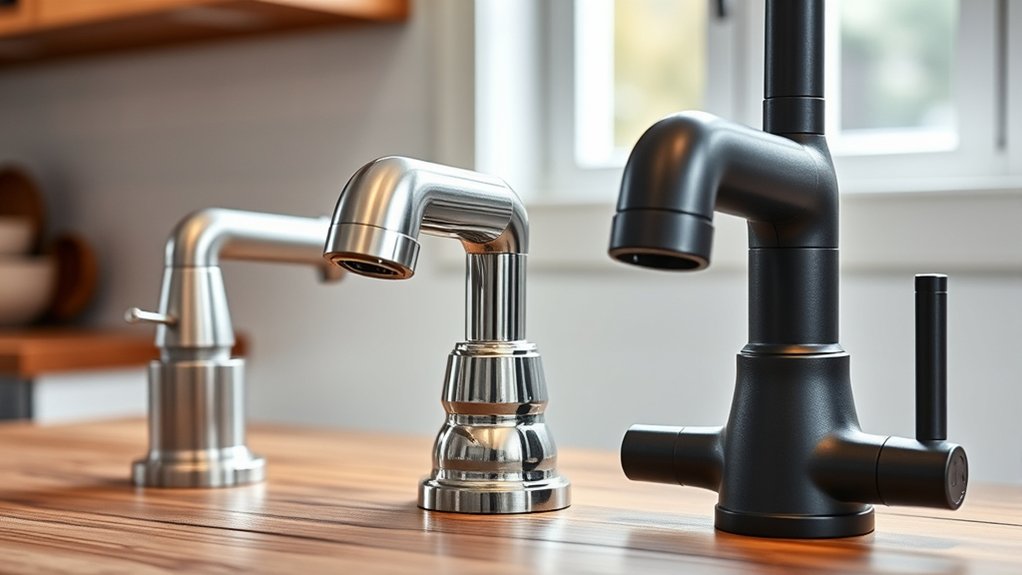
Are kitchen faucet heads universal? You can’t rely on them being so because thread sizes, connection types, and designs vary by brand and model.
You’ll need to match the faucet’s specific thread size—usually 55/64”–27 female or 15/16”–27 male—and confirm compatibility with your faucet’s type.
Improper fit leads to leaks or malfunction. Measuring your faucet carefully and choosing parts designed for your model guarantees success.
Keep exploring to learn how to identify and install the right faucet head with confidence.
Key Takeaways
- Kitchen faucet heads are not fully universal due to varying thread sizes and connection types.
- Common thread sizes include 55/64” 27 male or female, but many faucets require specific fittings.
- Brand and model differences significantly impact faucet head compatibility and installation ease.
- Accurate measurement of thread diameter, pitch, and spout dimensions is essential for selecting compatible heads.
- Universal faucet heads exist but may require adapters and may not fit all faucet types perfectly.
Are Kitchen Faucet Heads Universal?
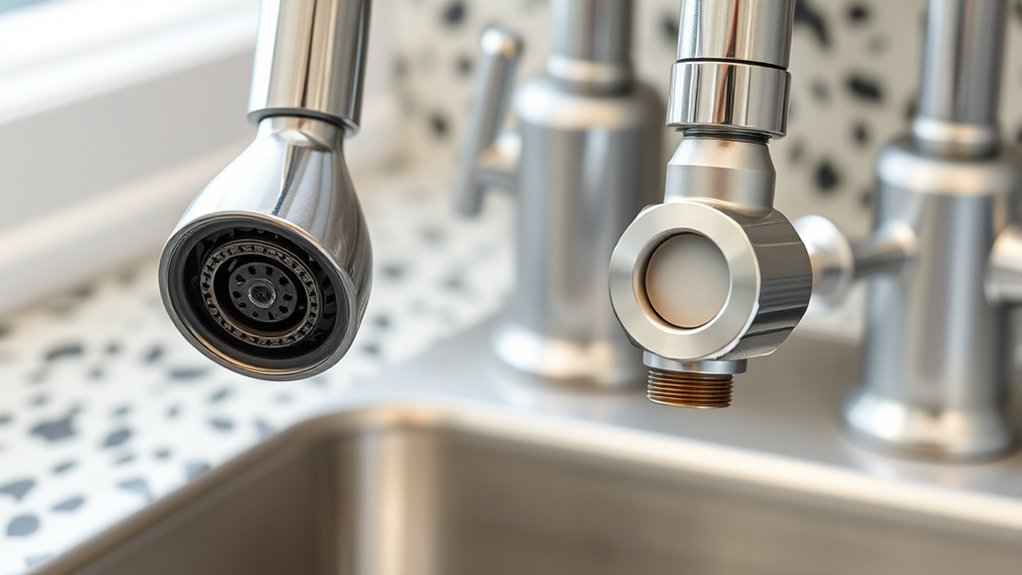
Are kitchen faucet heads universal, or do you need to take into account specific factors before replacement? Faucet types vary greatly, affecting compatibility. You can’t assume every faucet head fits all models.
Consider the connection size and threading. Most kitchen faucets use either 55/64” 27 male or 55/64” 27 female threads, but some differ. Also, check whether your faucet requires a pull-out, pull-down, or standard aerator head.
Installation tips include verifying the type of mounting and confirming the new head matches water flow requirements. You should also inspect for any integrated features like spray functions.
Taking these factors into account guarantees a proper fit and best performance, preventing leaks or malfunction. So, don’t overlook faucet types and installation details before replacing your faucet head.
Why Your Faucet’s Brand and Model Matter
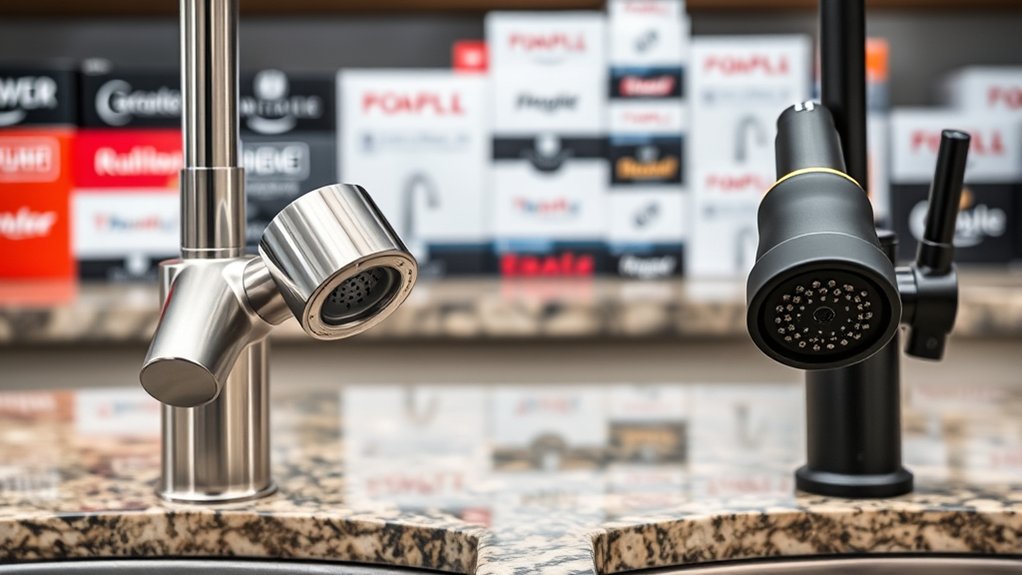
You need to take into account your faucet’s brand and model because design features often vary between manufacturers. Compatibility is essential to guarantee the replacement head fits securely and functions properly.
Additionally, availability of replacement parts depends heavily on the specific brand and model you own.
Brand-Specific Design Features
Because manufacturers design faucet heads with specific dimensions, connection types, and spray functions, compatibility depends heavily on your faucet’s brand and model. Each brand implements unique design variations that affect how replacement heads fit and perform.
For example, connection threading, nozzle diameter, and attachment mechanisms differ between brands, making universal interchangeability rare. Understanding brand compatibility is essential when selecting a faucet head to guarantee it seals properly and maintains intended water flow patterns.
Ignoring these brand-specific design features can lead to leaks, reduced functionality, or installation difficulties. To avoid these issues, always verify that the replacement part matches the original manufacturer’s specifications, focusing on the precise design elements that define your faucet’s brand lineage. This approach assures peak performance and longevity.
Model Compatibility Importance
When selecting a replacement faucet head, understanding your faucet’s exact brand and model is essential to guarantee proper fit and function. Faucet compatibility hinges on matching the threaded connections, spray settings, and water flow mechanisms specific to your model.
Even within the same brand, variations in design can affect how well a replacement part performs. You’ll find that some replacement options cater exclusively to certain model lines, ensuring seamless integration and avoiding leaks or malfunctions.
Ignoring model-specific requirements can lead to improper installation and reduced lifespan of the faucet head. By verifying your faucet’s model before purchasing, you streamline the selection process, secure peak performance, and avoid costly trial and error with incompatible components.
Always consult manufacturer specifications to confirm compatibility.
Replacement Part Availability
Although many faucet heads appear similar, their replacement parts vary considerably across brands and models, directly impacting availability. When you need to replace components, understanding your faucet’s brand and model helps you locate the correct replacement part types, such as aerators, cartridges, or spray valves.
Different faucet head materials, like brass, stainless steel, or plastic, also affect part compatibility and sourcing. Manufacturers design parts specifically for their models, so generic replacements often fail to fit or perform effectively.
By identifying your exact faucet specifications, you guarantee access to durable, compatible parts, reducing installation issues and prolonging faucet lifespan. Checking manufacturer catalogs or authorized dealers streamlines your search, avoiding delays caused by incompatible or substandard components.
This approach saves time and maintains your faucet’s functional integrity.
How Thread Sizes Affect Kitchen Faucet Head Fit
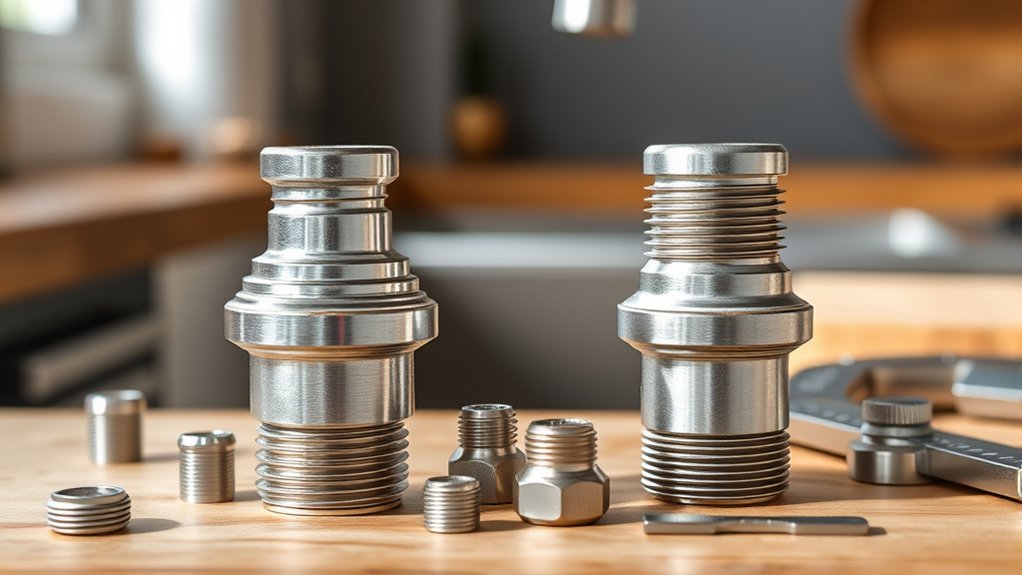
You’ll find that most kitchen faucet heads use common thread size standards, but variations can cause fit issues. To guarantee compatibility, measure your faucet’s thread diameter accurately with calipers or a thread gauge.
Keep in mind that differences in thread pitch also affect how securely the faucet head attaches.
Common Thread Size Standards
Since kitchen faucet heads connect directly to your water supply lines, their thread sizes must match precisely to ascertain a secure fit and prevent leaks. The most common thread size standards for kitchen faucets are 15/16”–27 for male threads and 55/64”–27 for female threads, both using a 27 threads per inch (TPI) pitch.
These standards stem from plumbing industry norms, but size variations do exist, especially with international or older models. Understanding these standards helps you identify compatible faucet heads without guesswork. If you encounter non-standard thread sizes, adapters may be necessary to establish a proper seal.
Measuring Faucet Thread Diameter
Accurately measuring the faucet thread diameter guarantees you select a kitchen faucet head that fits securely without leaks. Start by identifying the faucet thread types, typically male or female, and their standard sizes, such as 15/16″-27 for male threads or 55/64″-27 for female threads.
Use precise measurement tools like calipers or a thread gauge to measure the outer diameter of male threads or the inner diameter of female threads. Avoid relying on rulers, as they lack accuracy for small measurements. Confirm the measurement in both inches and millimeters to cross-check compatibility.
Proper measurement guarantees you avoid mismatched fittings that cause leaks or installation issues. This practical step is essential before purchasing replacement faucet heads or connectors to assure a tight, leak-free fit.
Impact of Thread Pitch Variations
Although thread diameter is essential, thread pitch, the distance between threads, plays an equally important role in making certain your kitchen faucet head fits properly. If the thread pitch on your faucet and the replacement head don’t match, the parts won’t engage correctly, leading to leaks or cross-threading.
Even when diameters align, a mismatch in thread pitch compromises faucet compatibility and can damage both components. To verify a secure fit, measure the thread pitch using a thread gauge or consult manufacturer specifications.
Standard kitchen faucets typically use a 27 TPI (threads per inch) pitch, but variations exist. Paying close attention to both diameter and thread pitch makes certain you select a faucet head that installs smoothly, functions reliably, and maintains a watertight seal.
How to Measure Your Kitchen Faucet for Replacement
When preparing to replace your kitchen faucet, you need to measure key dimensions carefully to verify compatibility. Start by measuring the diameter of the faucet’s spout where the aerator or faucet head attaches.
Use a caliper or ruler to get precise faucet dimensions, typically in millimeters or inches. Next, measure the thread pitch if possible, as variations affect fit. Also, note the length and reach of the spout to verify the new head aligns properly.
Consult replacement guides specific to your faucet brand or model to confirm these measurements correspond with available faucet heads. Accurate measurements prevent purchasing incompatible parts and streamline installation.
Keeping a detailed record of these faucet dimensions helps you select the correct replacement faucet head without trial and error.
Where to Buy Universal or Adapter Faucet Heads
After measuring your kitchen faucet and confirming the necessary dimensions, the next step is locating reliable sources for universal or adapter faucet heads. Start by exploring major hardware retailers like Home Depot or Lowe’s, which offer a range of universal faucet options compatible with various thread sizes and finishes.
Online marketplaces such as Amazon and eBay also provide extensive selections, often including specialized adapter faucet sources for uncommon fittings. Plumbing supply stores can be valuable for expert advice and high-quality parts tailored to your needs.
When selecting your faucet head, verify product specifications to guarantee compatibility with your measurements. By focusing on reputable vendors and clear product details, you’ll efficiently find the right universal or adapter faucet head to fit your kitchen faucet without guesswork or trial-and-error purchases.
How to Install and Test Your New Faucet Head
Start by shutting off the water supply to your kitchen faucet to prevent leaks during installation. Next, remove the old faucet head by unscrewing it counterclockwise. Follow these installation tips for a smooth process:
Begin by turning off your kitchen faucet’s water supply, then unscrew the old faucet head counterclockwise.
- Clean the threaded area to remove debris or old plumber’s tape.
- Wrap new plumber’s tape clockwise around the threads for a secure seal.
- Screw on the new faucet head clockwise by hand, then tighten gently with a wrench.
- Avoid overtightening to prevent damage to threads or fittings.
After installation, conduct the testing procedure by turning the water supply back on and checking for leaks. Run water through the faucet to verify consistent flow and proper aeration. Address any drips or irregularities immediately to confirm a successful installation.
Frequently Asked Questions
Can I Clean My Kitchen Faucet Head to Improve Water Flow?
Yes, you can improve water flow by cleaning your kitchen faucet head. Use effective cleaning techniques like soaking it in vinegar to dissolve mineral buildup, then scrub gently to guarantee peak performance and restore proper water pressure.
How Often Should I Replace My Kitchen Faucet Head?
You should replace your kitchen faucet head every 3-5 years or sooner if you notice replacement signs like leaks or reduced water flow. Regular faucet maintenance guarantees peak performance and prevents costly repairs.
Are There Eco-Friendly Kitchen Faucet Heads Available?
Yes, you can find eco-friendly kitchen faucet heads made from eco friendly materials like recycled metals and BPA-free plastics. These sustainable options reduce environmental impact while maintaining performance and durability in your daily kitchen use.
Can a Faulty Faucet Head Cause Leaks Under the Sink?
A faulty faucet head is the canary in the coal mine for leaks under your sink. Regular leak detection and faucet maintenance help you spot drips early, preventing water damage and costly repairs down the line.
Do Kitchen Faucet Heads Affect Water Pressure Significantly?
Yes, kitchen faucet heads directly impact water pressure and overall faucet performance. If the aerator or internal components clog or degrade, you’ll notice reduced flow.
Maintaining or replacing heads guarantees ideal water pressure and function.
Conclusion
Replacing your kitchen faucet head isn’t always a one-size-fits-all fix; it’s more like fitting a key to its lock. Knowing your faucet’s brand, model, and thread size sharpens your aim, ensuring a seamless match.
Measure carefully, shop smartly for universal or adapter options, and install with precision. When done right, your new faucet head will flow smoothly, turning everyday tasks into effortless rituals.
In conclusion, while some kitchen faucet heads may be marketed as universal, compatibility varies, so understanding your specific faucet details is essential for a proper fit.



Leave a Reply