
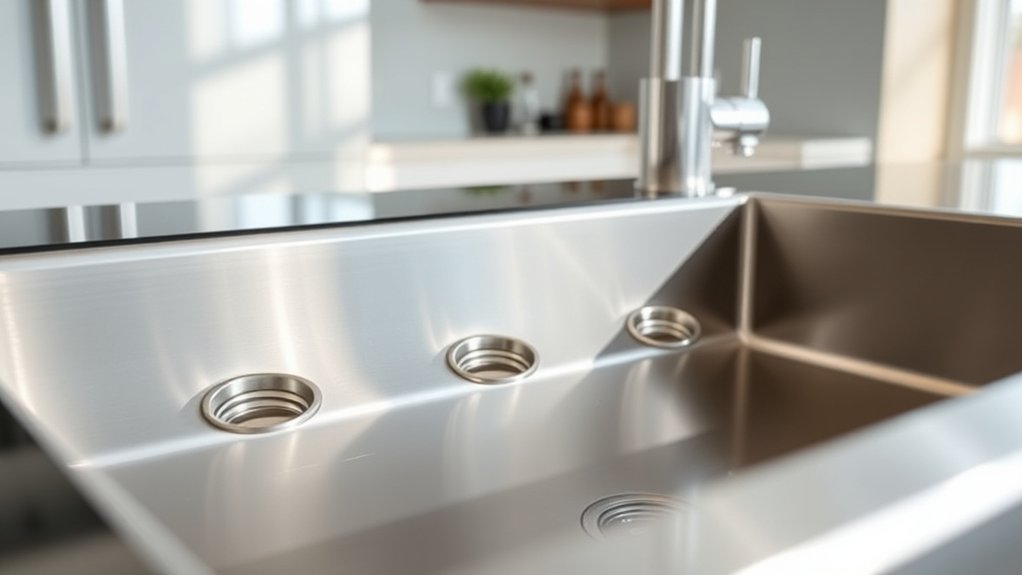
Kitchen faucet holes are mostly standardized, with a typical diameter of about 1.375 inches (35 mm), ensuring most faucets fit common sinks.
However, hole counts vary—usually one to four—and spacing ranges from 4 to 8 inches center-to-center, affecting faucet compatibility.
You’ll want to measure hole size and spacing accurately before buying a faucet to avoid installation issues.
Understanding these standards helps you pick the right faucet and achieve a secure, leak-free fit.
More details clarify how to measure and match your setup precisely.
Key Takeaways
- Most kitchen faucet holes have a standardized diameter of 1.375 inches (35 mm) for compatibility.
- Kitchen sinks typically feature one to four faucet holes, depending on faucet style and accessories.
- Common hole spacing includes 4-inch, 6-inch, and 8-inch center-to-center measurements.
- Proper hole size and spacing ensure secure mounting and prevent leaks during installation.
- Confirming hole dimensions and layout before purchase helps select compatible faucets and avoid fitting issues.
Are Kitchen Faucet Holes Standardized in Size?
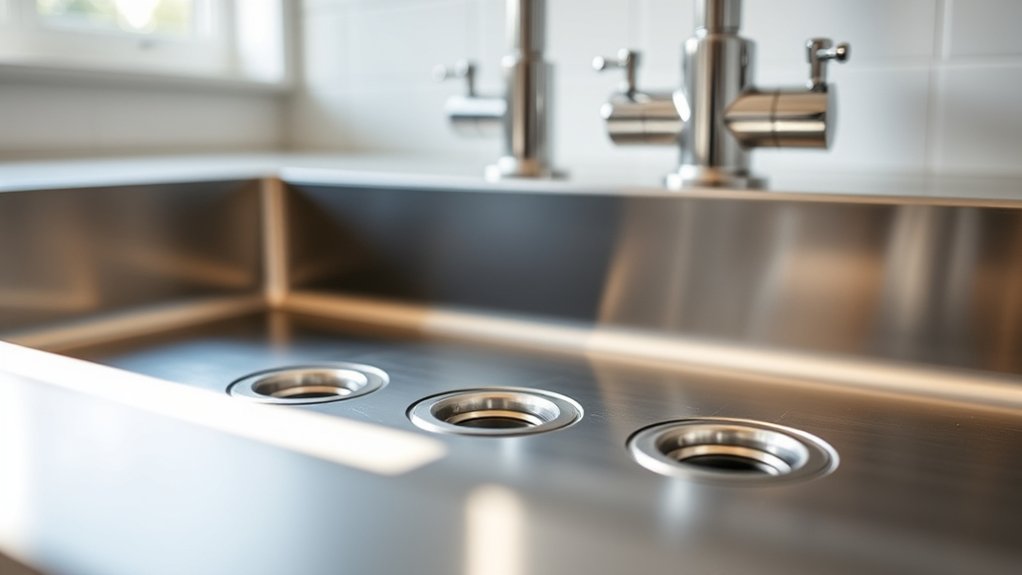
While kitchen faucet hole sizes can vary slightly, most manufacturers adhere to a general standard diameter of 1.375 inches (35 mm) for single holes. This standardization guarantees faucet compatibility across many sink models, simplifying installation and replacement.
When evaluating hole size, you need to measure the sink precisely to confirm it aligns with this standard or falls within acceptable tolerances. Deviations outside the typical range can hinder proper faucet mounting or require adapters.
Understanding that the hole size is critical for secure faucet attachment helps you avoid leaks or instability. As a result, confirming faucet compatibility by matching the hole diameter to manufacturer specifications is essential for a seamless fit, preventing issues during installation and promoting peak faucet performance.
How Many Kitchen Faucet Holes Does a Typical Sink Have?
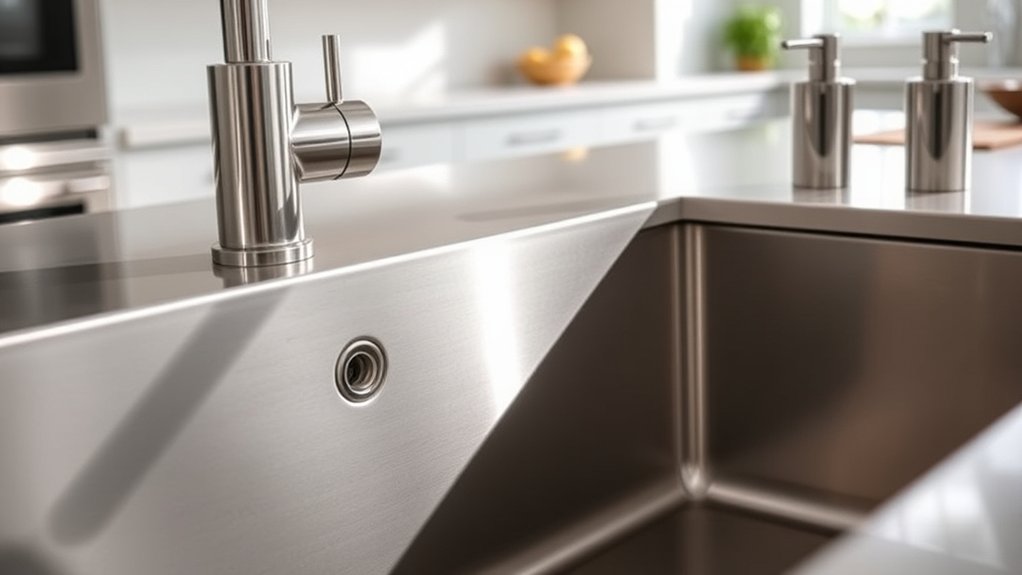
Most kitchen sinks feature between one and four faucet holes, depending on the sink design and intended faucet configuration. Single-hole sinks accommodate faucets with integrated sprayers or soap dispensers, ideal for minimalist designs.
Two-hole configurations typically support a faucet plus a separate handle or accessory. Three-hole setups are common, allowing for a faucet and two handles, one for hot water and one for cold, offering precise temperature control.
Four-hole sinks provide additional versatility, often used for faucets with side sprayers or filtered water taps. When selecting a sink, you must consider these faucet hole types and how they align with your preferred sink configurations to guarantee compatibility.
Understanding these variations helps you choose the right faucet and sink combination for efficient installation and operation.
Common Kitchen Faucet Hole Spacing Measurements
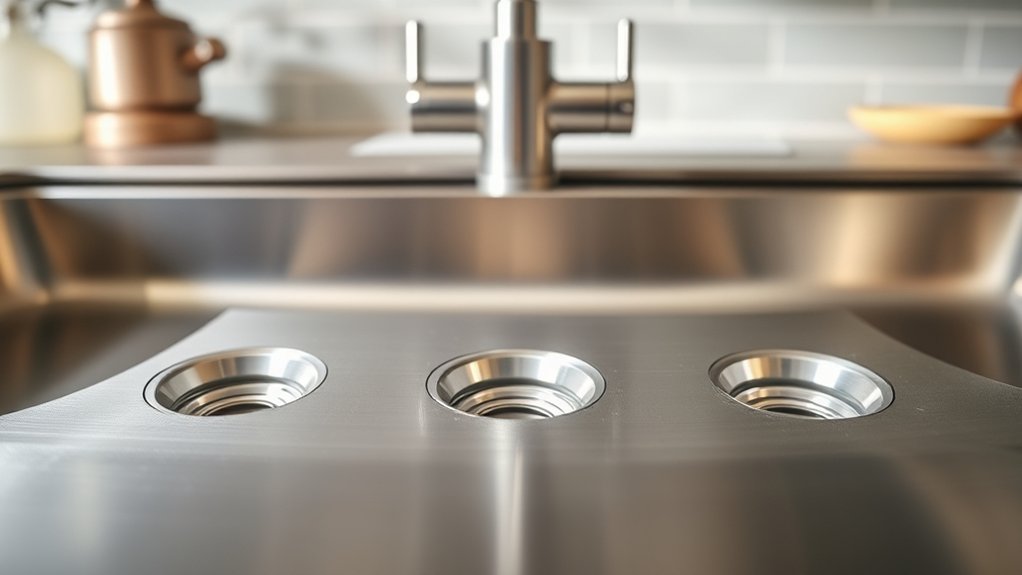
Knowing the number of faucet holes in your sink sets the stage for understanding their spacing, which directly affects faucet compatibility and installation ease. Most common kitchen sinks feature hole spacing of either 4 inches, 6 inches, or 8 inches center-to-center measurements.
For example, a standard 4-inch spread is typical for two-handle faucets, while 8-inch spacing accommodates widespread faucets. Hole alignment is critical during faucet installation, as misaligned holes can cause leaks or improper fitting.
You’ll want to confirm the faucet’s base matches your sink’s hole spacing to avoid modifications. When replacing or installing a new faucet, verifying these measurements confirms seamless integration. Proper spacing guarantees that the faucet operates efficiently and maintains structural stability over time.
How to Measure Your Kitchen Faucet Holes Accurately
To measure your kitchen faucet holes accurately, start by using a reliable tape measure or ruler to determine the center-to-center distance between the holes. Identify the faucet hole types: single-hole, centerset, or widespread, as each has distinct spacing requirements.
Place your measuring tool precisely at the center of one hole and extend it straight to the center of the adjacent hole, guaranteeing the tool remains level to avoid skewed readings. For multiple holes, measure distances between all relevant centers to confirm consistent spacing.
Also, measure the diameter of each hole to verify compatibility with faucet hardware. Accurate measurements using proper measuring tools help you avoid installation issues and guarantee the faucet fits securely and functions correctly within your sink or countertop configuration.
How to Choose a Faucet That Fits Your Kitchen Faucet Holes
Where do you start when selecting a faucet that matches your kitchen faucet holes? First, identify the number and spacing of your faucet holes. Then, choose faucet styles compatible with these configurations.
Consider single-hole, centerset, or widespread faucets based on your sink’s hole layout. Pay attention to installation tips, such as ensuring the faucet’s base plate covers unused holes or selecting models with adaptable mounting hardware.
| Faucet Styles | Installation Tips |
|---|---|
| Single-hole | Requires one mounting hole |
| Centerset (2-3 holes) | Combine spout and handles on one base |
| Widespread (3 holes) | Separate components, customizable spacing |
Match your faucet’s specifications precisely to your sink holes for a seamless, leak-free installation.
Frequently Asked Questions
What Tools Are Needed to Install a Kitchen Faucet?
You’ll need faucet installation tools like an adjustable wrench, basin wrench, plumber’s tape, and a screwdriver.
Understanding plumbing basics helps you tighten connections securely and prevent leaks during your kitchen faucet installation process efficiently.
Can I Convert a Single-Hole Sink to Accommodate Multiple Faucets?
You’d think converting a single-hole sink for multiple faucets is rocket science! With the right faucet conversion options, you can overcome sink compatibility issues by installing deck plates or drilling extra holes.
Just make sure to guarantee structural integrity and waterproofing first.
Are There Kitchen Faucet Holes Designed for Soap Dispensers?
Yes, kitchen faucet holes accommodate various soap dispenser types. They typically match standard faucet hole sizes, usually 1.25 to 1.5 inches in diameter, ensuring compatibility and ease of installation alongside your faucet setup.
How Do I Seal Around Faucet Holes to Prevent Leaks?
You’ll want to apply a generous bead of plumber’s putty or silicone sealant around the faucet holes during faucet installation to guarantee absolute leak prevention. This creates an airtight, watertight barrier that no droplet can ever breach.
What Materials Are Kitchen Sinks Commonly Made From?
You’ll find kitchen sinks commonly made from stainless steel, composite materials, ceramic sinks, and cast iron. Each offers distinct durability, maintenance needs, and aesthetic qualities, so choose based on your kitchen’s functional and design requirements.
Conclusion
When choosing your kitchen faucet, remember that while many faucet holes follow standard sizes, variations exist like unexpected twists in a well-planned recipe. Typically, sinks have one to four holes spaced commonly at 4 or 8 inches.
Accurately measuring your sink’s holes guarantees a perfect fit, avoiding costly mistakes. By understanding these standards and measurements, you’ll confidently select a faucet that fits seamlessly.
Making sure you know whether kitchen faucet holes are standard will help you choose the right faucet, ensuring your kitchen is both functional and stylish.

Leave a Reply