
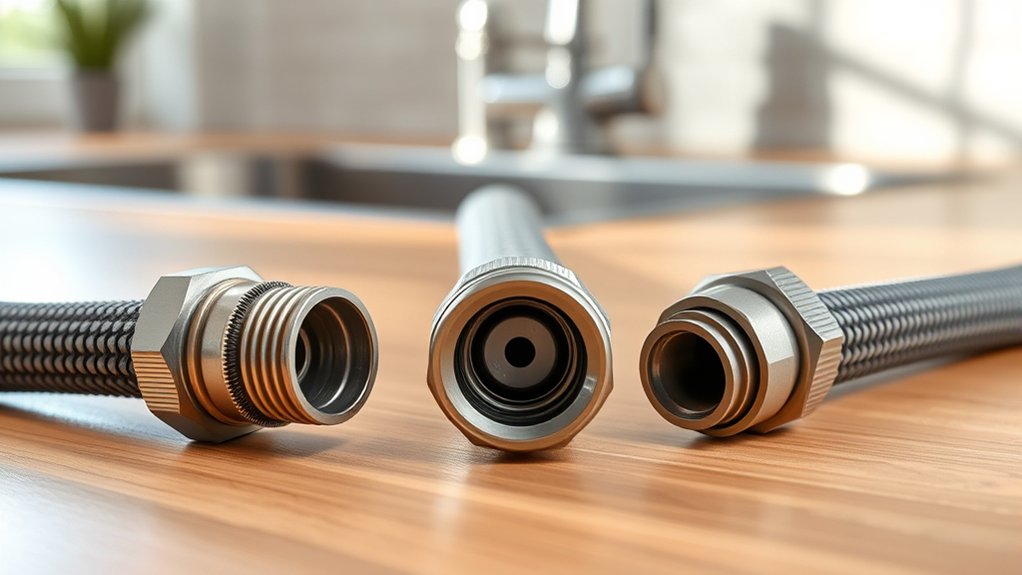
You can’t assume kitchen faucet hoses are universal because they differ in length, diameter, and connection types.
Many brands use proprietary fittings requiring specific hoses for a proper seal and performance. Accurately measuring hose length and connection size is crucial for compatibility.
Materials and certifications also affect durability and safety.
If you want to guarantee the right fit and understand when to replace the entire fixture or just a hose, further details will help guide you through the process.
Key Takeaways
- Kitchen faucet hoses vary in size, threading, and connection types, so they are not universally compatible.
- Some brands use proprietary hoses that fit only their faucets, limiting interchangeability.
- Measuring hose length and connection diameter is essential before purchasing a replacement hose.
- Universal hoses exist but must match the faucet’s thread size and connection type for proper fit.
- Always verify hose specifications and compatibility to ensure leak-free installation and optimal performance.
Are All Kitchen Faucet Hoses the Same Size and Length?
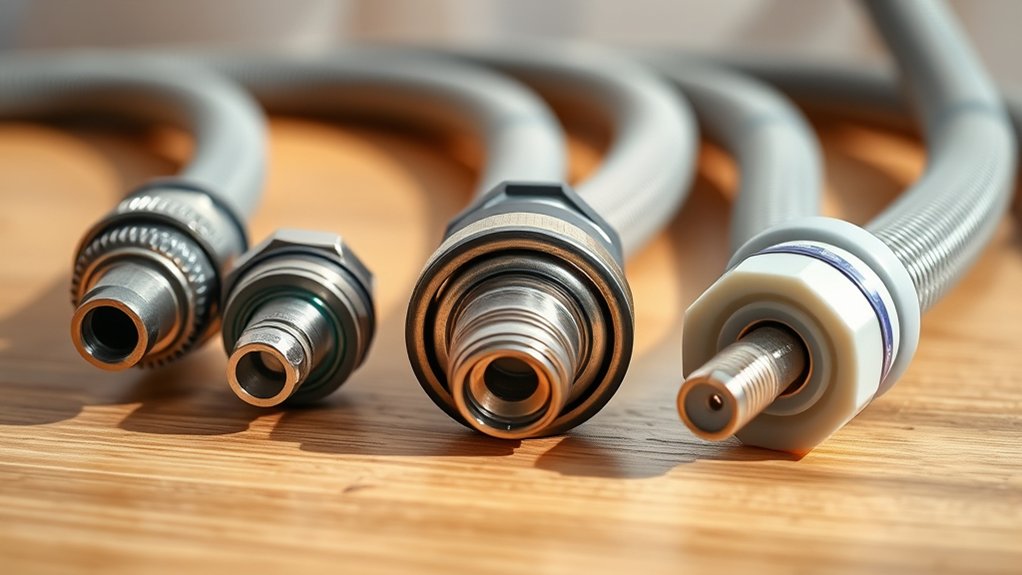
How do you determine the right size and length of a kitchen faucet hose? Start by measuring the distance from the faucet base to the water supply line, guaranteeing the hose will reach without tension.
Keep in mind hose diameter variations; common sizes include 1/2 inch and 3/8 inch, which affect flow rate and compatibility. You’ll also need to take into account hose material differences, such as braided stainless steel versus reinforced rubber, impacting durability and flexibility.
Selecting a hose with the appropriate diameter and material guarantees peak performance and longevity. Avoid assuming all hoses are universal; precise measurements and understanding these variables are essential for a proper fit and function in your kitchen setup.
How Do Faucet Hose Connection Types Affect Compatibility?
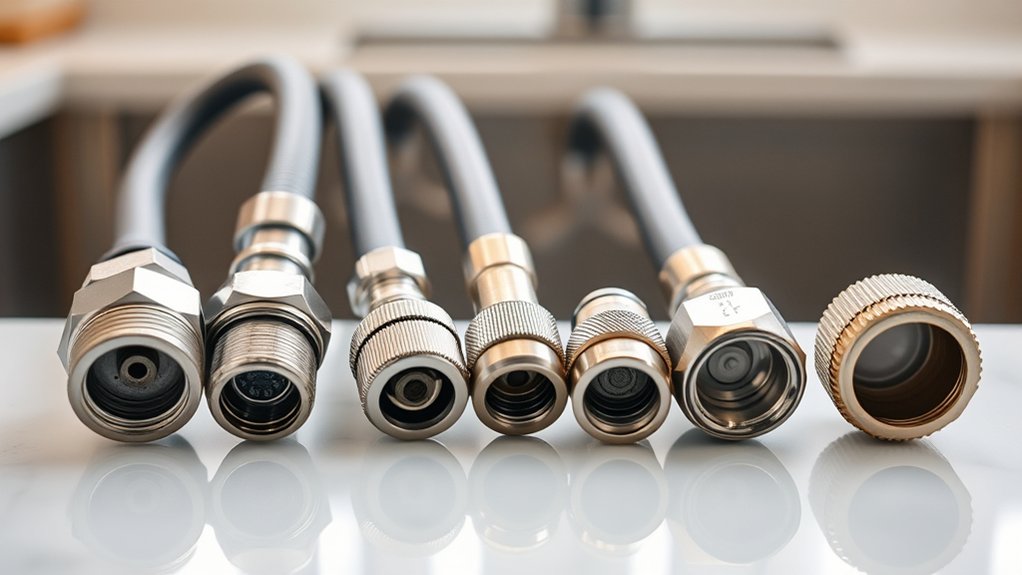
Since faucet hose connections vary widely, understanding their types is essential to guarantee compatibility with your kitchen setup. Hose types differ primarily by connection size, threading, and sealing methods.
Common connection standards include compression fittings, threaded connectors (usually 1/2-inch or 3/8-inch), and quick-connect systems. Each standard dictates how the hose mates with the faucet or water supply line, affecting leak prevention and ease of installation.
Common connection standards like compression fittings, threaded connectors, and quick-connects ensure secure, leak-free faucet hose installation.
If your hose’s connection type doesn’t match the faucet’s inlet, you’ll need an adapter or a replacement hose conforming to the correct standard. Being precise about these connection standards prevents incompatibility issues, ensuring a secure, leak-free fit.
Always check the hose types and the faucet’s required connection specifications before purchase or replacement.
Which Kitchen Faucet Brands Use Proprietary Hoses?
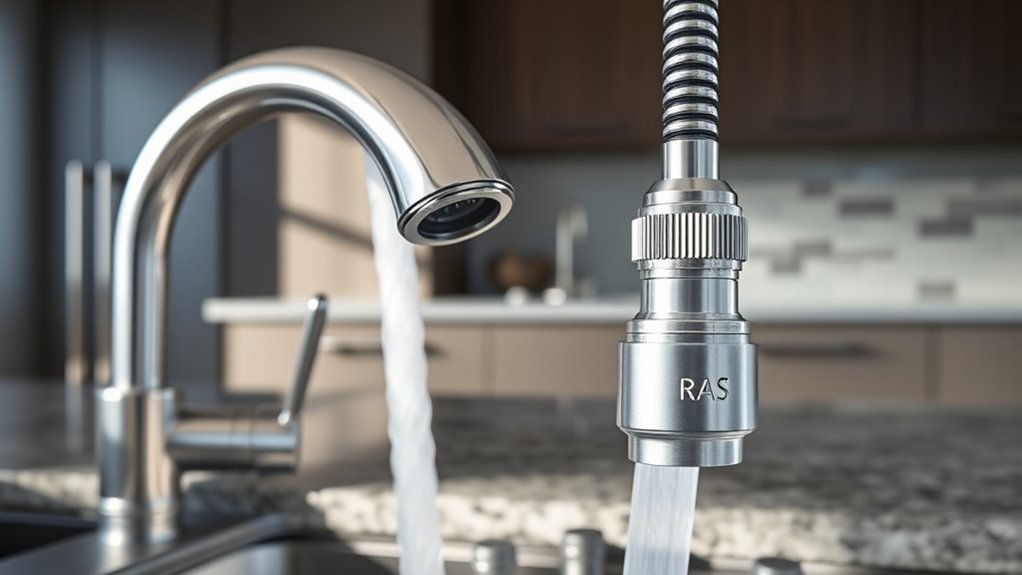
Certain kitchen faucet brands require proprietary hoses that don’t fit standard connections, so you’ll need to identify these custom fittings carefully. Recognizing proprietary connections involves checking specific thread sizes and unique coupling mechanisms used by the manufacturer.
Understanding these differences helps you avoid compatibility challenges when replacing or repairing your faucet hoses.
Brands With Custom Hoses
Several kitchen faucet brands design their products with proprietary hoses, which means you’ll need to use specific replacements or accessories compatible only with those brands. Custom hose manufacturers often collaborate with brands to guarantee precise fit and performance.
When sourcing replacements, consider hose installation tips like verifying connection types and avoiding excessive bending.
| Brand | Hose Type | Notes |
|---|---|---|
| Moen | Proprietary Quick-Connect | Requires brand-specific adapters |
| Delta | Custom Threaded | Unique threading, no universal fit |
| Kohler | Proprietary Couplings | Designed for exclusive use |
Understanding these specifics helps you avoid leaks or damage. Always check brand guidelines and consult custom hose manufacturers for compatible parts to guarantee a secure installation.
Identifying Proprietary Connections
Understanding which brands use proprietary hoses helps you identify the exact connection types you’ll encounter during installation or replacement. Some manufacturers employ proprietary designs deviating from common connection standards like 3/8-inch compression fittings.
Brands such as Moen and Kohler often use unique hose ends or quick-connect fittings incompatible with generic hoses. These proprietary designs guarantee brand-specific performance but limit interchangeability.
When you deal with faucets from these brands, you must source hoses explicitly labeled for that manufacturer to assure proper sealing and fit. Conversely, brands adhering to universal connection standards allow easier hose replacement with off-the-shelf parts.
Recognizing proprietary connections early prevents compatibility issues and guarantees you select the correct replacement hose, maintaining system integrity and avoiding leaks or installation delays.
Compatibility Challenges Explained
Maneuvering compatibility challenges requires you to know which kitchen faucet brands use proprietary hoses, as these unique fittings can complicate installation and replacements. Brands like Moen, Delta, and Kohler often employ proprietary hose materials and connector designs, limiting interchangeability with generic parts.
To avoid installation issues, carefully verify hose diameter, thread type, and connector shape before purchasing replacements. Installation tips include consulting manufacturer specifications and using adapter kits when available.
Understanding hose materials, such as braided stainless steel versus plastic, also influences compatibility and durability. By recognizing these brand-specific variations, you can prevent leaks, guarantee secure connections, and extend faucet lifespan.
Always prioritize matching proprietary hoses exactly to your faucet model for peak performance and simplified maintenance.
How to Measure Your Kitchen Faucet Hose for Replacement
To replace your kitchen faucet hose accurately, start by measuring the hose length from end to end without stretching it. Then, identify the connection size by checking the diameter of both ends, ensuring compatibility with your faucet.
These precise measurements will help you select the correct replacement hose.
Measuring Hose Length
Accurately measuring your kitchen faucet hose length is essential for ensuring a proper fit during replacement. Start by fully extending the hose from the faucet to the supply valve, avoiding kinks that might distort the measurement. Use a flexible tape measure for precision, as hose durability depends on avoiding overstretching or bending during installation.
Note the total length to select a replacement hose that meets this exact size, ensuring smooth installation and ideal performance.
| Step | Action |
|---|---|
| 1 | Turn off water supply |
| 2 | Detach old hose carefully |
| 3 | Fully extend hose for measuring |
| 4 | Measure using flexible tape |
Following these installation tips will maintain hose durability and prevent leaks.
Checking Connection Size
After measuring the hose length, you’ll need to verify the connection size to ascertain compatibility with your faucet and water supply. Start by identifying the connection types, typically compression fittings, threaded connectors, or quick-connect couplings.
Use a caliper or ruler to measure the inner and outer diameters of the hose ends precisely. Note that faucet hose materials, such as braided stainless steel or reinforced rubber, can affect flexibility but not the connection size.
Check the thread pitch if your hose has threaded fittings; this guarantees a proper seal and leak-free connection. Finally, compare your measurements with the replacement hose specifications to confirm a perfect match.
Accurate measurement prevents installation issues and prolongs the hose’s service life.
How to Choose the Right Universal Kitchen Faucet Hose
How do you determine the best universal kitchen faucet hose for your setup? Start by ensuring universal compatibility with your faucet’s connection size and thread type. Next, evaluate the hose material; stainless steel or reinforced braided nylon offer durability and resistance to kinks.
Also, consider hose length to fit your sink configuration without excess slack or tension. Finally, check for certifications ensuring safety and compliance with plumbing standards.
Confirm connection size matches your faucet precisely
Choose durable, kink-resistant hose material
Measure the required hose length accurately
Verify compliance certifications for quality assurance
When to Replace the Entire Kitchen Faucet Instead of the Hose
When should you consider replacing your entire kitchen faucet instead of just the hose? If your faucet lifespan is nearing 10-15 years, or you notice multiple replacement signs like persistent leaks, corrosion, or decreased water pressure, it’s time to replace the whole unit.
Hose replacement only addresses specific issues, but systemic wear in internal components often compromises faucet functionality. Additionally, if the faucet’s finish is severely damaged or the mounting hardware is unstable, replacing the entire faucet guarantees long-term reliability.
Upgrading also allows you to install newer models with improved water efficiency and features. Focus on thorough replacement when repair costs approach the price of a new faucet or when parts become incompatible, assuring a durable and efficient kitchen water system.
How to Safely Install or Swap a Kitchen Faucet Hose
Although replacing a kitchen faucet hose may seem straightforward, you need to follow specific safety steps to avoid water damage and guarantee a secure fit. Begin by shutting off the water supply and relieving pressure by opening the faucet.
Use proper tools to disconnect the old hose carefully, preventing damage to fittings. When installing the new hose, make certain it matches the faucet’s specifications. Tighten connections securely but avoid overtightening, which can cause leaks.
Incorporate these installation tips for efficient hose maintenance:
- Verify compatibility before installation
- Inspect and clean fittings thoroughly
- Use plumber’s tape on threaded connections
- Test for leaks by slowly turning the water back on
Following these steps guarantees a safe, durable swap, minimizing risks and extending your faucet’s lifespan.
Frequently Asked Questions
Can Kitchen Faucet Hoses Affect Water Pressure?
Yes, kitchen faucet hoses can affect water pressure. If the hose diameter is too narrow, it restricts flow, lowering pressure.
Conversely, a wider diameter maintains ideal water pressure, ensuring efficient performance at your sink.
Are There Eco-Friendly Kitchen Faucet Hoses Available?
You know, “a stitch in time saves nine.” You’ll find eco-friendly options made from sustainable materials like biodegradable polymers and recycled metals, ensuring durability and reducing environmental impact while maintaining performance and safety in your kitchen faucet hoses.
How Long Do Kitchen Faucet Hoses Typically Last?
Kitchen faucet hoses typically last 5-10 years. Watch for replacement signs like leaks or kinks.
Confirm hose compatibility during replacement to avoid fitting issues and maintain proper water flow and durability in your kitchen setup.
Can I Use a Kitchen Faucet Hose for a Bathroom Sink?
You can use a kitchen faucet hose for a bathroom sink if the hose dimensions match your bathroom faucet’s fittings.
Verify kitchen compatibility carefully, as differences in size or connectors may affect proper installation and function.
What Materials Are Kitchen Faucet Hoses Made From?
Kitchen hose materials typically include braided stainless steel, rubber, and reinforced nylon, ensuring faucet hose durability.
You’ll find stainless steel offers corrosion resistance, while rubber and nylon provide flexibility and strength for reliable water flow and longevity.
Conclusion
Think of your kitchen faucet hose like a puzzle piece—while many seem to fit, not all align perfectly. Sizes, connection types, and brand specifics create subtle differences you can’t ignore. Measuring carefully and choosing the right hose guarantees a seamless fit, much like finding the exact key for a lock.
When in doubt, replacing the whole faucet might save you time and effort. Approach the task methodically, and your kitchen will flow smoothly again. Remember, kitchen faucet hoses are not universal, so selecting the correct one is essential for proper installation and function.

Leave a Reply