
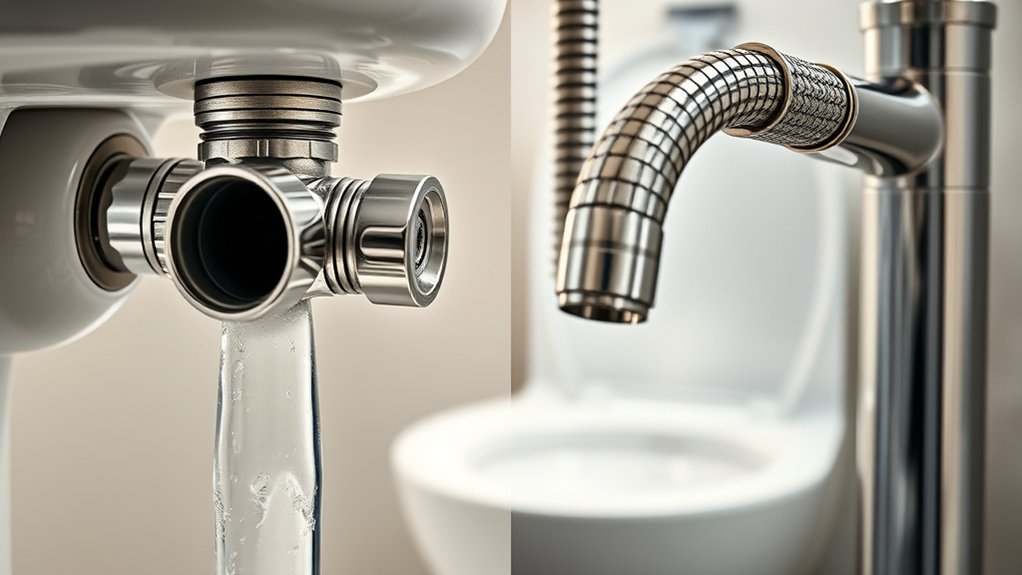
Are Toilet and Faucet Supply Lines the Same? You can’t assume they are because they differ in materials, sizes, and fittings.
Toilet supply lines usually have larger diameters and are built for higher water pressure, often made from braided stainless steel for durability.
Faucet supply lines tend to be smaller and more flexible, sometimes made from reinforced nylon.
Using the wrong line can cause leaks or poor flow.
To guarantee a proper fit, you’ll want to understand these key differences and selection tips.
Key Takeaways
- Toilet supply lines usually have larger diameters and are designed to handle higher water pressure than faucet supply lines.
- Faucet supply lines often have smaller connectors and vary more in length compared to toilet supply lines.
- Using faucet supply lines for toilets may cause leaks or poor performance due to size and material differences.
- Both supply lines differ in material durability, with toilet lines often made from stronger materials like braided stainless steel.
- Always match diameter, length, and connection type to fixture specifications for proper fit and function.
What Materials Are Toilet and Faucet Supply Lines Made Of?
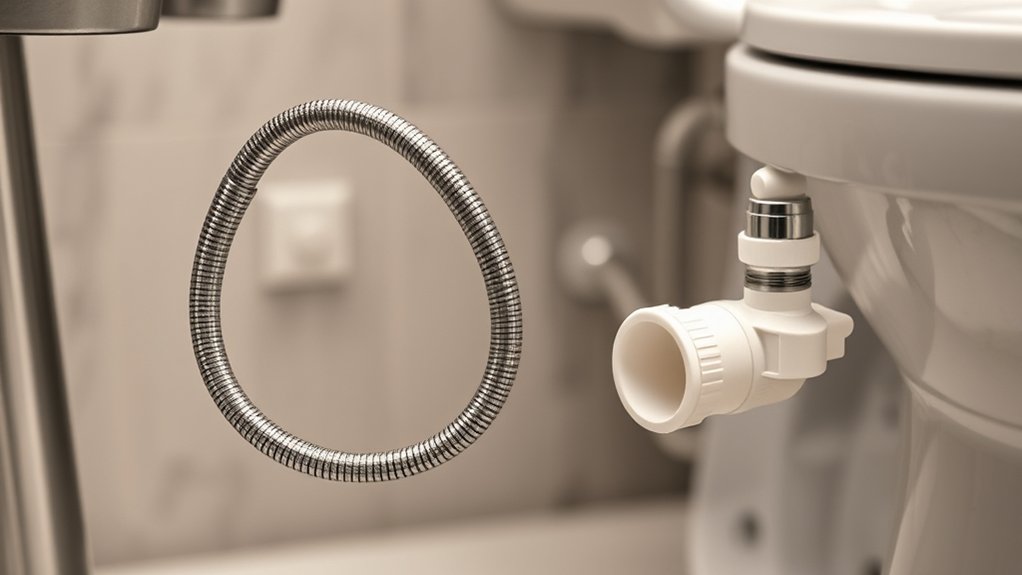
When selecting toilet and faucet supply lines, you’ll encounter several common materials, each with distinct properties affecting durability, flexibility, and corrosion resistance. Flexible hoses typically use braided stainless steel or reinforced nylon, offering excellent material durability and resistance to kinks and corrosion.
Braided stainless steel lines provide superior strength and longevity, making them ideal for areas prone to wear. Reinforced nylon hoses, while flexible and corrosion-resistant, may have lower durability under high pressure or extreme temperatures.
Some supply lines use rubber or PVC, but these tend to degrade faster and offer less flexibility. Understanding these material characteristics helps you choose supply lines that balance flexibility with long-term durability, ensuring reliable water delivery without frequent replacements or failures in your plumbing system.
Can You Use Faucet Supply Lines for Toilets? What to Know
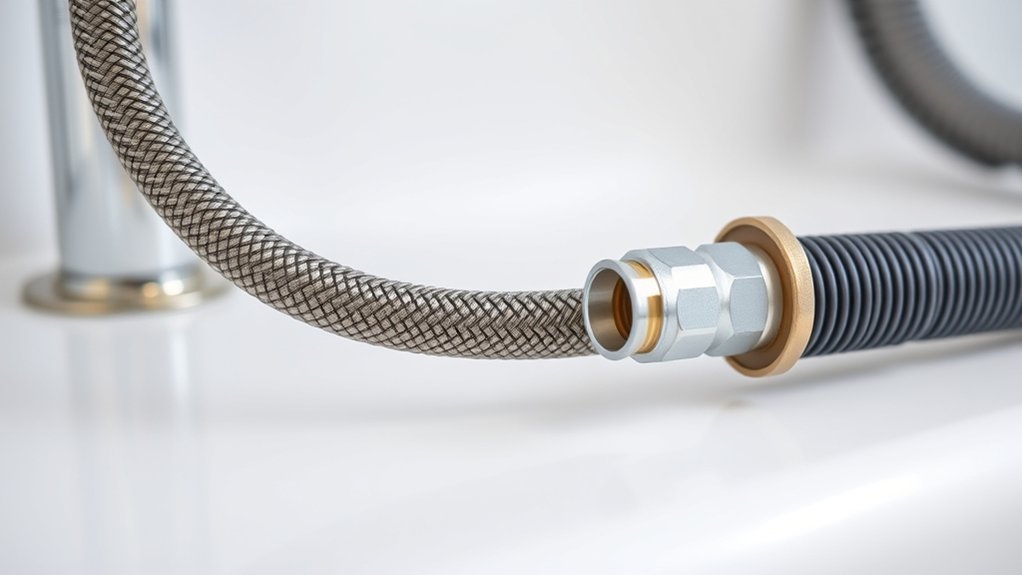
How suitable are faucet supply lines for toilet installations? While faucet supply lines might seem interchangeable, you need to take into account faucet compatibility and the specific supply line types designed for toilets. Using faucet supply lines on toilets can work if the connectors and diameters match, but it’s not always ideal.
Faucet supply lines may fit toilets if connectors match, but they’re not always the best choice.
Keep in mind:
- Faucet supply lines often have smaller connectors than toilet lines.
- Toilet supply lines are built to handle higher water volume and pressure.
- Material and length differences affect durability and fit.
Before substituting, verify fittings and confirm the supply line type matches your toilet’s requirements. Using the wrong line can cause leaks or poor performance. Always prioritize compatibility and function over convenience when choosing between faucet and toilet supply lines.
How Do Toilet and Faucet Supply Lines Differ in Size and Length?
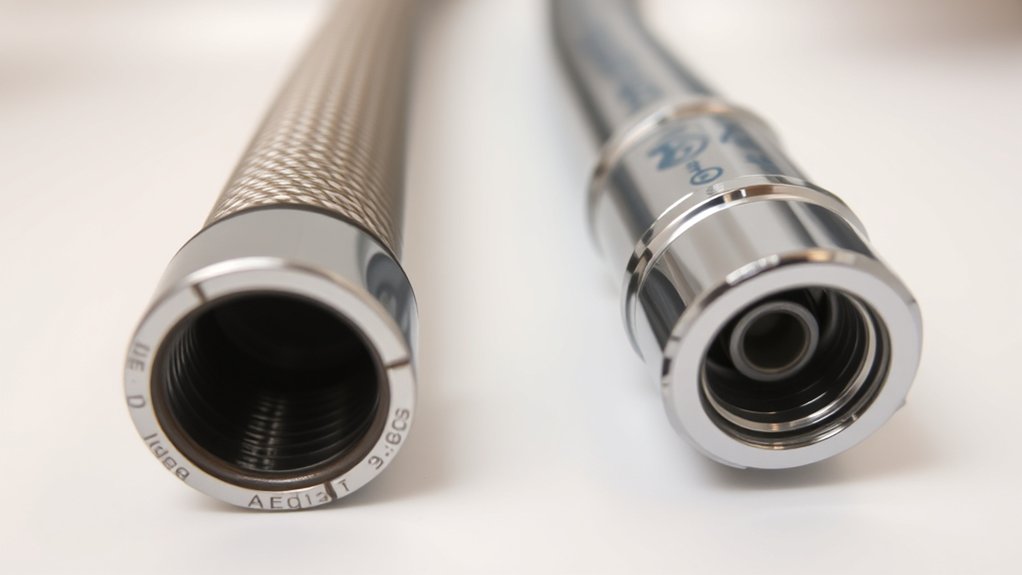
Why do size and length matter so much between toilet and faucet supply lines? It comes down to the distinct Toilet Sizes and Faucet Lengths designed for each fixture. Toilet supply lines typically have a larger diameter, commonly 7/8-inch or 3/8-inch compression fittings, to accommodate higher water flow demands.
Their lengths also vary but generally range between 12 to 20 inches to connect the shutoff valve to the toilet tank comfortably.
Conversely, faucet supply lines use smaller diameters, often 3/8-inch or 1/4-inch, reflecting lower water flow requirements. Faucet Lengths are more diverse, spanning from 12 to 60 inches, to fit different sink configurations and wall distances.
Using mismatched sizes or lengths risks leaks, inadequate water flow, or installation stress. So, understanding these precise differences guarantees reliable, efficient plumbing connections.
How to Choose the Right Supply Line for Your Toilet or Faucet
Selecting the right supply line for your toilet or faucet requires matching the line’s diameter, length, and connection type to your fixture’s specifications. Start by identifying the correct supply line types compatible with your fixture.
Next, measure the distance from the shut-off valve to the fixture to determine the appropriate length. Finally, confirm the connection fittings on both ends align with your plumbing setup to avoid leaks or cross-threading.
Keep these installation tips in mind:
- Always verify the supply line’s material and flexibility to suit your space constraints.
- Use Teflon tape on threaded connections for a secure seal.
- Avoid over-tightening fittings to prevent damage to threads or valves.
Following these practical steps guarantees a safe, efficient supply line installation.
Frequently Asked Questions
How Often Should Supply Lines Be Replaced?
You should replace supply lines every 5 to 7 years, depending on supply line materials and supply line maintenance.
Regularly inspect for wear, corrosion, or leaks to guarantee peak performance and prevent water damage.
Can Supply Lines Cause Leaks if Not Installed Properly?
Yes, improper installation can cause leaks. For leak prevention, follow installation tips like tightening connections securely, avoiding overtightening, using plumber’s tape on threads, and checking for damage before installation.
These steps help guarantee a reliable, leak-free supply line.
Are There Any Special Tools Needed for Installation?
Think of your wrench as the key to a locked door; without it, installation’s impossible. For supply lines, you’ll need adjustable wrenches and possibly pliers.
Follow installation tips carefully; tool requirements guarantee secure, leak-free connections.
Do Supply Lines Affect Water Pressure?
Yes, supply lines can affect water pressure depending on their diameter and supply line materials. Thinner or restrictive materials reduce flow, so choosing high-quality, appropriately sized lines guarantees ideal water pressure for your fixtures.
Can Supply Lines Be Used With Water Filters?
You absolutely can’t just slap any supply line onto a water filter! Check water filter compatibility and supply line materials carefully to guarantee proper fit, avoid leaks, and maintain ideal filtration performance for your system’s longevity and efficiency.
Conclusion
When choosing supply lines, remember that about 60% of leaks in bathrooms stem from improper fittings. Toilet and faucet supply lines differ significantly in size, length, and material flexibility. Using the wrong one can cause leaks or damage.
Always select lines designed for your fixture type to guarantee a secure fit and the best performance. Matching the right supply line prevents costly repairs and keeps your plumbing reliable over time.
In conclusion, toilet and faucet supply lines are not the same, so it’s important to use the correct type for each fixture to ensure durability and leak-free connections.



Leave a Reply