
Can any faucet fit my sink? The answer is no—not every faucet will fit your sink. You need to match your sink’s pre-drilled faucet holes—count, spacing, and diameter—to the faucet’s mounting requirements precisely.
Check your sink’s hole layout: single, centerset, or widespread.
Also, consider material compatibility and plumbing connections for a secure fit. Using adapters may help, but only if alignment and structural support are sound.
Understanding these factors guarantees proper installation and performance. Explore further details to pick the right faucet for your sink.
Key Takeaways
- Faucet compatibility depends on the sink’s number, size, and spacing of pre-drilled mounting holes.
- Measure hole spacing accurately to match faucet types: single-hole, centerset, or widespread.
- Faucet material and finish should complement the sink for durability and aesthetics.
- Structural support and plumbing connections must be compatible to ensure proper installation and function.
- Use adapters or escutcheons if faucet holes don’t align perfectly, but verify compatibility first.
Can Any Faucet Fit My Sink? Understanding Compatibility
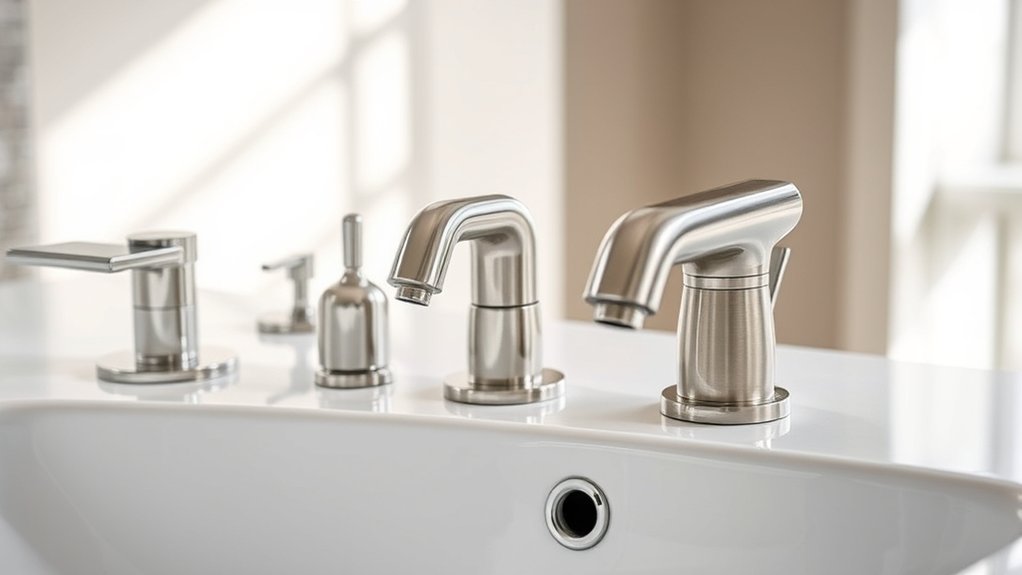
How do you determine if a faucet will fit your sink? First, assess the compatibility between faucet materials and sink finishes to guarantee durability and aesthetic coherence. Different faucet materials, such as brass, stainless steel, or chrome, interact uniquely with various sink finishes like porcelain, stainless steel, or composite.
You’ll want to select faucet materials that resist corrosion and complement the finish of your sink to avoid premature wear. Additionally, consider the mounting type, as deck-mounted faucets differ from wall-mounted ones, affecting fit. Confirm dimensions match precisely, including spout reach and height, to prevent splashing or awkward installation.
Why Your Sink’s Faucet Hole Count Matters
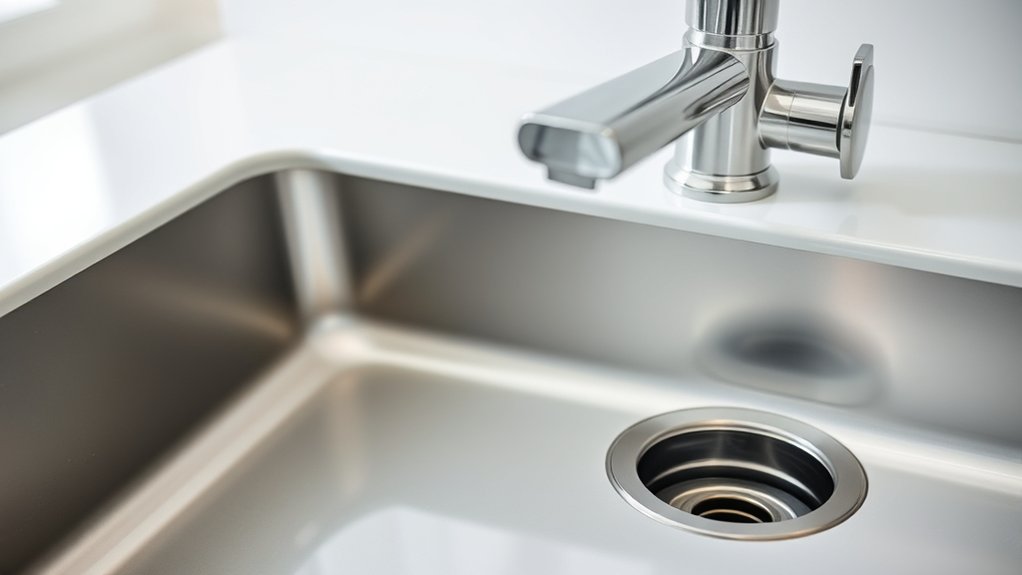
The number of faucet holes in your sink directly determines the types of faucets you can install. Each hole corresponds to a specific function or component, so matching faucet types to hole count is critical. Different sink materials often come pre-drilled with a fixed hole number, limiting your faucet options.
Here’s why hole count matters:
- Single-hole sinks suit single-handle faucets or pull-out sprayers.
- Two-hole sinks accommodate faucets with side sprayers or soap dispensers.
- Three-hole sinks fit widespread or centerset faucets with separate handles.
- More than three holes allow for additional accessories or custom setups.
How to Match Faucet Hole Spacing for a Perfect Fit
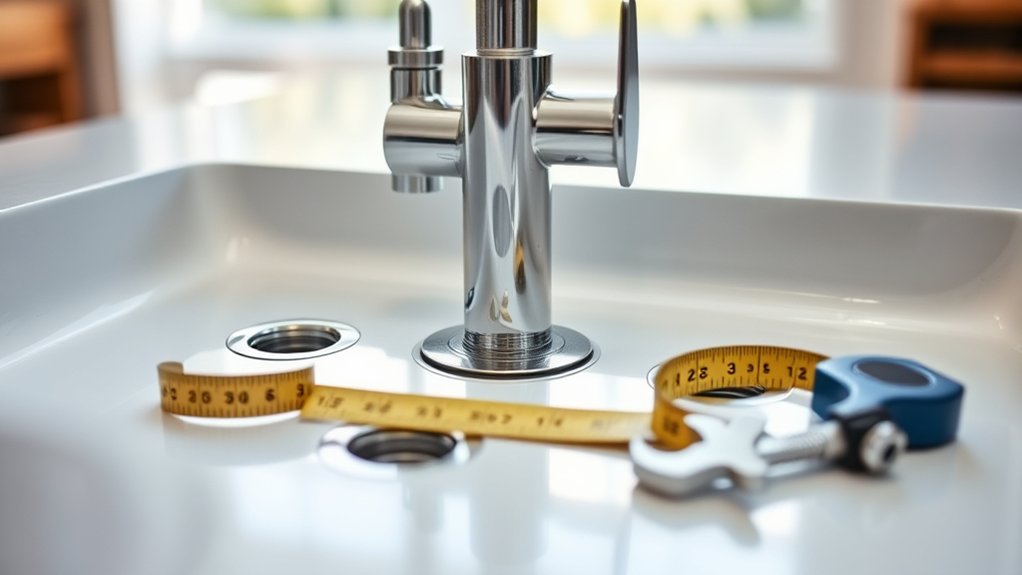
Start by accurately measuring the distance between your sink’s faucet holes to guarantee compatibility. Different sink configurations require specific spacing, so identify whether you have a single-hole, centerset, or widespread setup.
If your faucet doesn’t align perfectly, consider adapters or escutcheons to achieve a secure, leak-free fit.
Measuring Faucet Hole Spacing
Accurately measuring the spacing between faucet holes is essential to guarantee a seamless fit with your sink. To verify you match the faucet to your sink’s configuration, follow these steps using precise measuring tools:
- Use a ruler or caliper to measure the center-to-center distance between adjacent faucet holes.
- Record the measurement in millimeters or inches for accuracy.
- Compare your measurement to standard spacing guidelines. Common spacings include 4 inches (single-hole) and 8 inches (widespread).
- Verify the total number of holes and their alignment to confirm compatibility.
Types Of Sink Configurations
When selecting a faucet, you’ll need to evaluate your sink’s hole configuration carefully, as it directly affects compatibility and installation ease. Sink styles vary, typically featuring one, three, or four holes.
Single-hole sinks accommodate faucets with integrated handles, while three-hole sinks usually require separate hot and cold handles alongside the spout. The spacing between these holes, commonly 4 or 8 inches, determines compatible faucet designs.
Some sinks have widespread configurations with adjustable spacing, offering flexibility in faucet choice. Understanding your sink’s hole count and spacing guarantees you select a faucet design that fits without modification.
Ignoring these details can lead to installation challenges or the need for additional adapters. Matching faucet designs to your sink’s hole layout assures a secure, functional, and aesthetically pleasing setup.
Adapting Faucets To Sinks
How do you guarantee your faucet aligns perfectly with your sink’s hole spacing? First, measure the distance between the holes on your sink precisely. Adapting faucets to sinks requires matching these measurements with the faucet types designed for that spacing.
Remember, different sink materials, like stainless steel or cast iron, may affect installation flexibility. Follow these steps to verify compatibility:
- Identify your sink’s hole count and spacing (e.g., 4 inches, 8 inches).
- Select a faucet type specifically designed for that spacing, such as center set or widespread.
- Confirm the faucet’s base plate or escutcheon accommodates your sink’s hole layout.
- Consider extension kits or adapters only if manufacturer-approved to avoid leaks or instability.
Which Faucet Styles Work Best With Different Sink Types?
Although choosing a faucet may seem straightforward, selecting the right style depends heavily on your sink type to guarantee proper fit and functionality. For example, undermount sinks pair well with single-hole faucets, maximizing countertop space and facilitating easy cleaning.
Vessel sinks require tall or wall-mounted faucets to accommodate their height, preventing splashing. Drop-in sinks typically suit centerset or widespread faucets, depending on pre-drilled holes.
When considering faucet finishes, match them with your sink materials for durability and aesthetics. Brushed nickel complements stainless steel sinks, while oil-rubbed bronze pairs well with cast iron.
Also, verify the faucet’s reach and spout height align with your sink’s basin size to avoid water splatter or awkward angles. Proper alignment verifies ideal water flow and maintains your kitchen or bathroom’s clean look.
Can Adapters Help Any Faucet Fit Your Sink?
You can use various faucet adapters to bridge differences between your faucet and sink connections, such as thread size or mounting type. Installing these adapters typically involves securing them between the faucet and the water supply lines or sink holes, requiring basic plumbing tools.
However, you must verify compatibility to confirm the adapter fits both your faucet’s specifications and your sink’s configuration.
Types Of Faucet Adapters
Several types of faucet adapters exist to bridge compatibility gaps between faucets and sinks, enabling you to fit fixtures that might otherwise be incompatible. When selecting an adapter, consider the faucet types and the specific adapter sizes required for your installation.
Here are four common types:
1. Threaded adapters
Convert between different thread sizes or types, essential when faucet and sink connections differ.
2. Compression adapters
Facilitate connections where compression fittings meet threaded or slip joints.
3. Escutcheon adapters
Fill oversized holes on the sink deck to accommodate standard faucet sizes.
4. Thread-to-slip adapters
Allow threaded faucets to connect with slip-fit sink fittings.
Installation Process Overview
When installing a faucet, adapters can often resolve compatibility issues between your chosen fixture and sink, but they don’t guarantee a perfect fit in every situation. Begin by gathering essential installation tools: adjustable wrenches, basin wrench, plumber’s tape, and a bucket.
Identify the faucet type—single-hole, center-set, or widespread—as it influences adapter selection and installation steps. Remove the old faucet carefully, disconnecting water supply lines using the appropriate tools.
Install the adapter if needed, making certain of a secure seal with plumber’s tape to prevent leaks. Position the new faucet, tighten mounting nuts using a basin wrench, and reconnect the water lines.
Finally, test for leaks and proper operation. Precise alignment and correct tool use are vital throughout to secure a successful installation.
Compatibility Considerations
Although adapters can address many faucet-to-sink mismatches, they won’t guarantee compatibility in every scenario. You need to review several technical factors to ascertain a proper fit between your faucet and sink designs.
First, verify the mounting hole size and spacing on your sink. Second, check the faucet materials to ensure they won’t corrode or degrade when connected via an adapter. Third, confirm that the water supply lines align correctly with the adapter fittings.
Fourth, evaluate the sink’s structural support to handle the faucet’s weight and leverage. Ignoring these factors can lead to leaks, poor function, or damage. Adapters help, but only when these compatibility assessments are met precisely and practically.
Replacing Faucets in Older Sinks: What You Need to Know
Because older sinks often feature non-standard hole configurations and dimensions, replacing their faucets requires careful measurement and compatibility checks. Start by measuring the number, spacing, and diameter of your sink’s mounting holes.
Older sink types may have fewer or irregularly spaced holes compared to modern standards. You’ll need to select faucet styles designed to fit these unique layouts or consider adapters.
Additionally, verify that the faucet’s base and mounting hardware align with your sink’s thickness and material. Pay attention to water supply line connections, as older plumbing might not match current fittings. Ensuring compatibility prevents leaks and installation issues.
How to Choose a Faucet That Fits Your Sink and Matches Your Style
Selecting a faucet that fits your sink and matches your style requires careful consideration of both functional specifications and design elements. To guarantee compatibility and enhance sink aesthetics, focus on these key factors:
- Measure your sink’s mounting holes to choose a faucet with the correct configuration (single-hole, centerset, or widespread).
- Match faucet finishes with existing hardware or décor for a cohesive look.
- Consider spout height and reach to avoid splashing and guarantee ergonomic use.
- Evaluate the overall design style, whether modern, traditional, or transitional, to complement your sink’s aesthetics.
Frequently Asked Questions
How Do I Maintain My Faucet to Prevent Leaks?
You should perform regular maintenance by checking and tightening connections, cleaning aerators, and replacing worn washers or O-rings promptly. This leak prevention routine guarantees your faucet operates efficiently and minimizes water waste effectively.
What Tools Do I Need for Faucet Installation?
You’ll need an adjustable wrench, basin wrench, plumber’s tape, screwdriver, and plumber’s putty.
Knowing your faucet types helps you follow installation steps precisely, ensuring secure connections and proper sealing during faucet installation.
Can I Install a Faucet Myself Without Professional Help?
Think of faucet installation as assembling a puzzle; with the right tools and patience, you can master DIY plumbing. Follow precise steps, guarantee proper fittings, and you’ll confidently install your faucet yourself without needing professional help.
How Do I Clean and Care for Different Faucet Finishes?
You’ll clean faucet materials like chrome with mild soap and water, avoid abrasives on brass finishes, and use vinegar for mineral deposits. Tailor cleaning techniques to each finish to maintain durability and appearance effectively.
What Are Common Signs That My Faucet Needs Replacement?
Don’t ignore faucet leaks; they’re clear replacement indicators. You’ll notice constant dripping, corrosion, reduced water flow, or difficulty turning handles.
Acting promptly prevents water damage and high bills, ensuring your sink functions smoothly and efficiently.
Conclusion
You might think any faucet fits your sink, but precision matters—hole count, spacing, and style all play vital roles.
While adapters can bridge some gaps, they’re not a universal fix. Choosing the right faucet means balancing technical compatibility with your personal style.
Don’t settle for a mismatch or a makeshift solution; instead, guarantee your faucet fits perfectly to avoid leaks, instability, or frustration. When considering can any faucet fit my sink, remember that careful selection is key.

Leave a Reply