
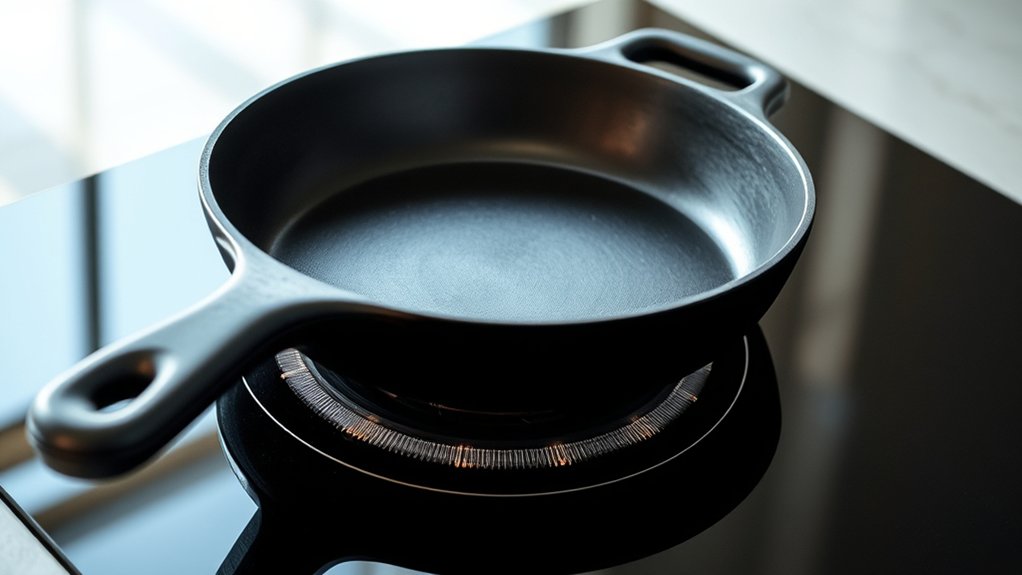
Can cast iron skillet be used on induction cooktop? Yes, it can. Cast iron’s ferromagnetic properties make it highly compatible with induction’s electromagnetic heating.
Your skillet will heat quickly and evenly, delivering precise temperature control and excellent heat retention.
Just verify your skillet’s base is flat for the best contact and avoid sliding it to protect your glass surface.
If you want to understand performance nuances and care tips, keep exploring how cast iron pairs with induction cooking.
Key Takeaways
- Cast iron skillets are compatible with induction cooktops due to their ferromagnetic properties enabling magnetic heating.
- Induction cooktops heat cast iron quickly and evenly through electromagnetic fields generating heat directly inside the skillet.
- Enameled cast iron skillets work well on induction, but ensure the base is flat and smooth for optimal contact and heat transfer.
- Use protective mats and lift skillets when placing on induction surfaces to prevent scratches and preserve enamel coatings.
- Cast iron on induction offers precise temperature control, excellent heat retention, and durability without warping or performance loss.
Can You Use Cast Iron Skillets on Induction Cooktops?
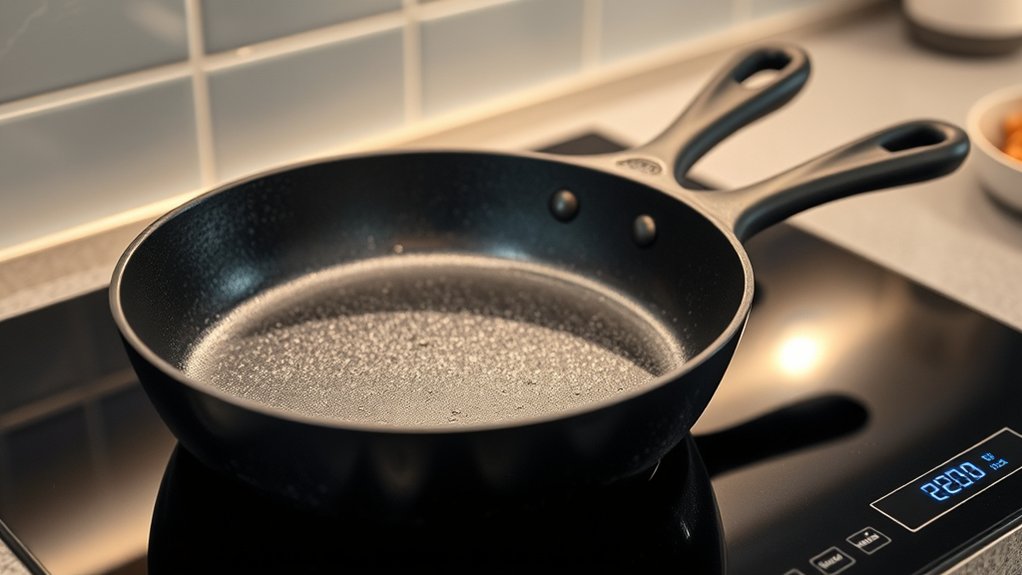
How well does a cast iron skillet perform on an induction cooktop? You’ll find cast iron is exceptionally compatible with induction technology due to its ferromagnetic properties.
When you place a cast iron skillet on an induction cooktop, the magnetic field directly induces heat in the pan, resulting in high induction efficiency. This means your skillet heats quickly and maintains consistent temperatures, ideal for precise cooking tasks.
Unlike non-magnetic cookware, cast iron maximizes energy transfer, reducing heat loss and cooking times. However, you should ascertain the skillet’s base is flat and makes full contact with the cooktop surface to optimize induction efficiency.
How Induction Cooking Heats Cast Iron Skillets
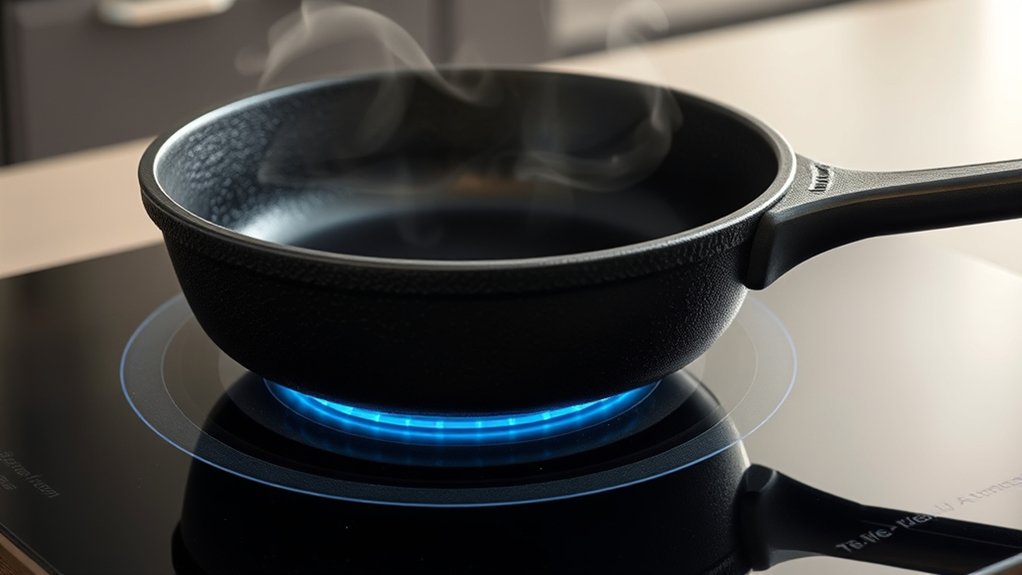
Induction cooktops generate heat through electromagnetic fields that interact directly with the cast iron skillet’s metal. This induction heating causes electric currents, called eddy currents, to flow within the skillet’s iron, rapidly producing heat.
Unlike traditional cooking, heat isn’t transferred from the cooktop surface but is created inside the skillet itself, ensuring exceptional skillet efficiency. You’ll notice the skillet heats evenly and quickly, minimizing energy loss.
Heat forms inside the skillet, not on the cooktop, for quick, even heating and minimal energy loss.
With induction heating, you benefit from:
- Faster cooking times that save you effort
- Precise temperature control for perfect meals
- Reduced energy consumption, cutting costs
- Minimal heat wastage, keeping your kitchen cooler
- Enhanced skillet responsiveness to heat adjustments
Understanding this process lets you maximize your cast iron skillet’s performance on induction cooktops confidently.
Why Cast Iron Is Ideal for Induction Cooking
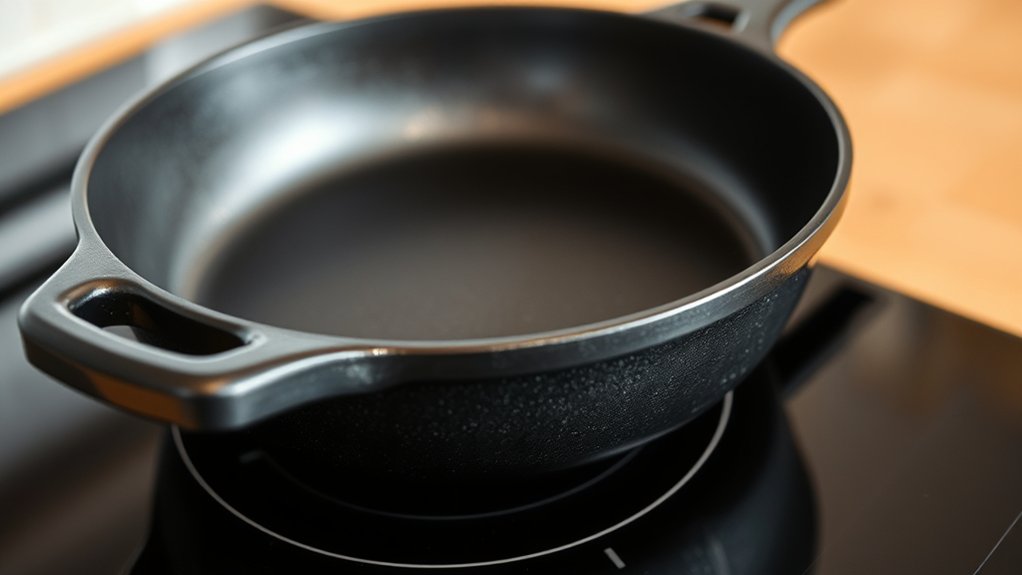
Because cast iron contains ferromagnetic properties, it responds exceptionally well to the electromagnetic fields generated by induction cooktops, making it one of the most efficient materials for this cooking method. You’ll experience peak induction efficiency as cast iron quickly absorbs and retains heat, minimizing energy loss.
Among the cast iron benefits, its heavy, dense structure guarantees even heat distribution, preventing hot spots that could compromise your cooking. This stability also allows you to maintain consistent temperatures for precise cooking control.
Additionally, cast iron’s durability means it withstands the high heat levels induction cooktops can produce without warping. By using cast iron on induction, you leverage both the cookware’s natural properties and the technology’s precise heating, resulting in superior cooking performance and energy conservation.
How to Tell If Your Cast Iron Skillet Works on Induction
Wondering whether your cast iron skillet is compatible with your induction cooktop? The easiest way to confirm skillet compatibility is the magnet test. Simply place a magnet on the bottom of your skillet; if it sticks firmly, your skillet will work on induction.
Here’s what to take into account:
- Verify the skillet’s base is flat and smooth for best contact.
- A strong magnetic attraction indicates excellent induction performance.
- Skillets with enamel coatings usually pass the magnet test.
- Lightweight or thin cast iron may have weaker magnetic response.
- Avoid aluminum or copper-bottomed pans as they fail the magnet test.
Common Issues When Cooking With Cast Iron on Induction
Although cast iron skillets generally work well on induction cooktops, you may encounter specific challenges that affect cooking performance. One primary issue is uneven heat distribution; cast iron heats slowly and retains heat intensely, which can cause hot spots if not monitored carefully.
You’ll need to preheat the skillet gradually to guarantee consistent temperature across the surface. Weight considerations also play an essential role. Cast iron is heavy, and excessive pressure or sudden movements can strain or damage the induction cooktop’s glass surface.
Additionally, the skillet’s thickness may interfere with the cooktop’s sensor, occasionally causing erratic heating. Being aware of these factors helps you optimize your cooking technique and maintain your induction cooktop’s functionality while using cast iron skillets.
Protecting Your Induction Cooktop From Cast Iron Scratches
To prevent scratches on your induction cooktop from cast iron skillets, always use protective cooktop mats designed for this purpose. Make it a habit to lift your skillet instead of sliding it across the surface to avoid abrasive damage.
Additionally, regularly clean the cooktop to remove any debris that could cause scratches during cooking.
Use Protective Cooktop Mats
While cast iron skillets offer excellent cooking performance on induction cooktops, their rough surfaces can easily scratch the glass. To preserve your cooktop’s pristine condition, use protective mats designed specifically for induction surfaces. These mats create a barrier between the skillet and the cooking surface, preventing abrasions without interfering with heat transfer.
When selecting protective mats, choose those made from heat-resistant, non-slip materials to guarantee safety and durability. Using these mats offers several benefits:
- Shields the cooktop from unsightly scratches
- Maintains the smooth, sleek appearance of your appliance
- Extends the lifespan of your induction surface
- Provides peace of mind during heavy cooking
- Enhances overall kitchen safety
Incorporating protective mats into your routine is a simple, effective way to safeguard your investment.
Lift Instead Of Slide
Three simple words can save your induction cooktop from costly scratches: lift instead of slide. Proper lifting of your cast iron skillet eliminates abrasive contact that occurs during skillet sliding, preventing surface damage.
Always grasp the skillet firmly and raise it vertically before repositioning. Avoid dragging or pushing it across the glass-ceramic surface to maintain its pristine condition.
| Action | Method | Result |
|---|---|---|
| Proper Lifting | Grasp handles firmly | No surface abrasion |
| Skillet Sliding | Dragging/skidding | Potential scratches |
| Cooktop Surface | Smooth glass-ceramic | Susceptible to damage |
| Prevention | Lift, don’t slide | Prolongs cooktop lifespan |
Adopting proper lifting over skillet sliding guarantees your induction cooktop remains scratch-free and fully functional.
Regularly Clean Cooktop Surface
Maintaining a clean cooktop surface after each use considerably reduces the risk of scratches caused by cast iron skillets. You must adopt effective cleaning techniques focused on removing debris and residue without damaging the glass surface. Consistent surface maintenance preserves both the appearance and functionality of your induction cooktop, preventing abrasive particles from causing micro-scratches when you place or lift your skillet.
To protect your cooktop, follow these essential steps:
- Use a soft microfiber cloth or sponge for gentle wiping
- Avoid abrasive cleaners or scrubbers that can etch the surface
- Clean spills immediately, especially sugary or acidic substances
- Employ a recommended cooktop cleaner for stubborn stains
- Dry the surface thoroughly before placing cookware
Prioritize these cleaning techniques to confidently maintain your induction cooktop’s pristine condition.
Can You Use Enameled Cast Iron Skillets on Induction Cooktops?
How well do enameled cast iron skillets perform on induction cooktops? Enameled cast iron offers excellent induction compatibility due to its ferrous core, which efficiently responds to the magnetic field generated by the cooktop. You can confidently use these skillets without worrying about performance loss or damage.
However, because the enamel coating is delicate, you should avoid sliding the skillet aggressively on the glass surface to prevent chipping. Also, make sure the skillet’s base is flat to maximize contact and heat distribution. Enameled cast skillets heat evenly and retain heat well, making them ideal for induction cooking.
To conclude, you get the durability and heat retention of cast iron combined with the smooth, easy-to-clean surface of enamel, perfectly suited for induction cooktops.
Frequently Asked Questions
How Do You Season a Cast Iron Skillet for Induction Cooking?
You season your cast iron skillet for induction compatibility by cleaning it, applying a thin layer of oil, then heating it in the oven at 450°F for an hour. Repeat seasoning techniques regularly to maintain a smooth, non-stick surface.
Can Cast Iron Skillets Cause Uneven Heating on Induction Cooktops?
Like a patchy quilt, cast iron skillets can cause uneven heat on induction cooktops, reducing cooking efficiency. You should preheat slowly and move the skillet to distribute heat evenly for precise, consistent results every time you cook.
Are There Specific Brands of Cast Iron Best for Induction?
You’ll find Le Creuset options and Lodge products excel on induction cooktops. Both offer durable, smooth-bottomed cast iron skillets that guarantee even heating and compatibility, making them top choices for induction cooking enthusiasts like you.
How Heavy Is a Cast Iron Skillet Compared to Other Cookware?
You’ll find cast iron weight considerably heavier than most cookware, often double or triple that of aluminum or stainless steel pans. This heft guarantees superior heat retention but demands careful handling during cooking and cleaning tasks.
Can You Use a Cast Iron Skillet on Induction Cooktops Without a Flat Bottom?
You can’t rely on cast iron compatibility with induction cooking if the skillet lacks a flat bottom. Uneven contact disrupts magnetic induction, causing poor heat transfer and inefficient cooking. Always choose flat-bottomed cast iron for ideal performance.
Conclusion
You might think using cast iron on induction is simple, but the real secret lies in how you handle it. While cast iron’s magnetic properties make it perfect for induction, overlooking scratches or uneven heating can cost you more than just a scratched cooktop.
Before you place that skillet down, consider the care and precision required—because mastering this combo isn’t just about cooking; it’s about preserving your cookware and your induction surface for years to come.
Ultimately, knowing that a cast iron skillet can be used on an induction cooktop safely will help you enjoy the best of both worlds without damage or frustration.

Leave a Reply