
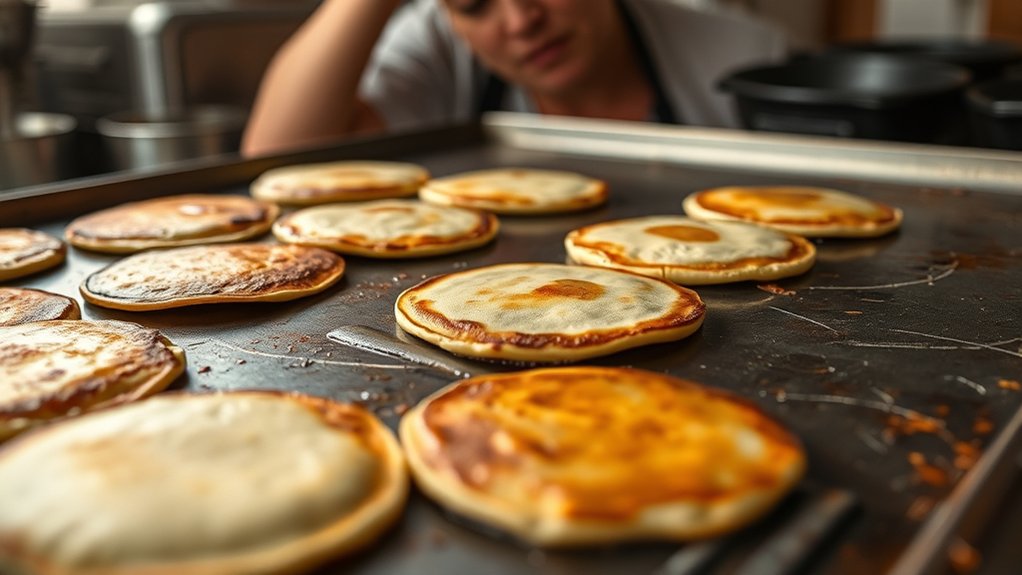
You’ll find griddles require ample space, often disrupting kitchen flow, which is one of the main disadvantages of a griddle.
They also struggle with uneven heating that demands constant attention to prevent hot or cold spots.
Cleaning is tough, needing special care to avoid damage and maintain seasoning.
They’re limited for certain cooking styles, especially delicate baking or saucy dishes, which can restrict their versatility.
Additionally, griddles can rack up costs due to energy use and maintenance.
Safety risks like burns and grease fires add to concerns.
There’s more you should know before deciding.
Key Takeaways
- Large griddles require significant countertop space and proper ventilation, which can disrupt kitchen workflow.
- Uneven heat distribution causes hot and cold spots, leading to inconsistent cooking results.
- Cleaning requires special care and frequent maintenance to prevent residue buildup and surface damage.
- High-quality griddles have significant upfront costs and can increase energy consumption during prolonged use.
- Safety risks include grease fires, burns, and the need for constant supervision while operating.
Griddle Size and Kitchen Space Requirements
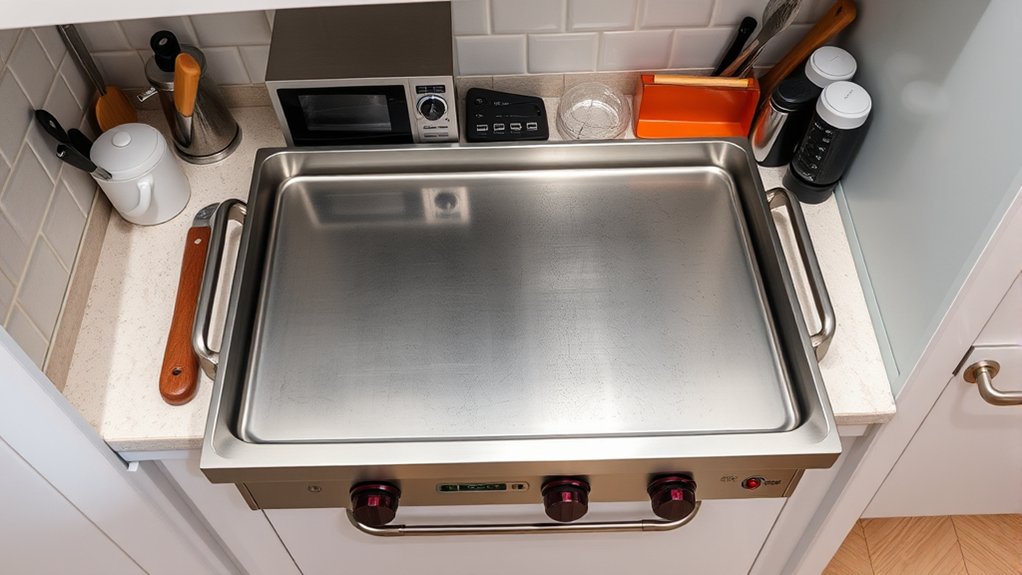
Although griddles offer ample cooking surface, their size can pose significant challenges in kitchens with limited space. When considering griddle dimensions, you must evaluate your kitchen layout carefully.
Large griddles, often exceeding 24 inches in width and 18 inches in depth, demand substantial countertop or stovetop space, which may disrupt workflow or reduce available prep areas. You’ll need to measure precisely to guarantee the griddle fits without obstructing other appliances or compromising safety clearances.
Additionally, griddles require ventilation space and easy access for cleaning, further impacting your kitchen layout decisions. If your kitchen is compact, installing a full-sized griddle may force you to rearrange equipment or sacrifice storage, affecting overall efficiency.
Balancing griddle size with your kitchen layout is critical for maximum use.
Uneven Heating Issues With Griddles
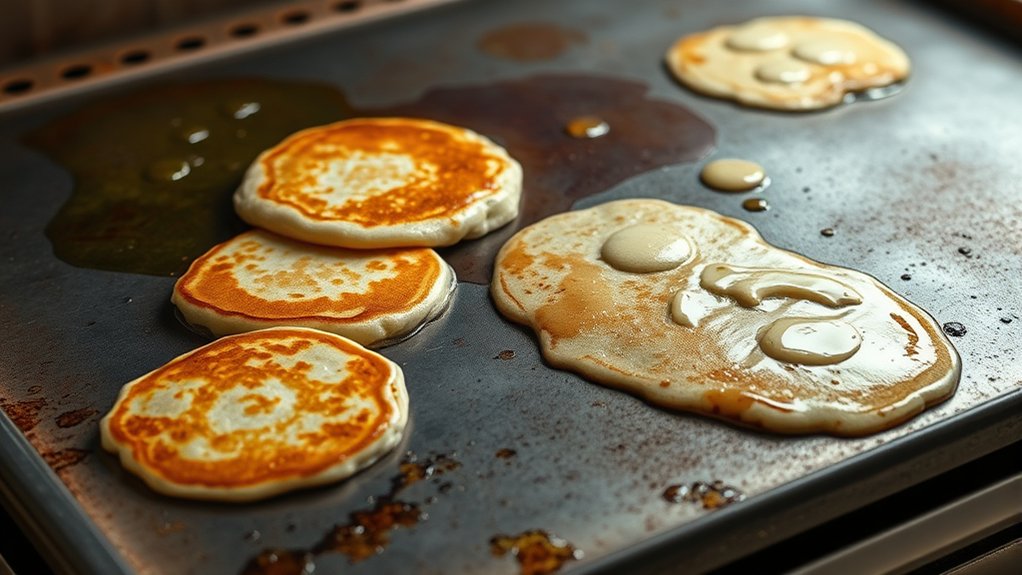
While fitting a griddle into your kitchen layout demands careful measurement, managing its heat distribution poses another practical challenge. Uneven heating causes temperature fluctuations across the surface, affecting cooking consistency. You might find some areas hotter, leading to burnt spots, while others remain undercooked.
This inconsistency requires you to constantly monitor and adjust food placement.
| Issue | Cause | Effect |
|---|---|---|
| Hot spots | Poor heat conduction | Food burns in localized areas |
| Cold spots | Insufficient heat spread | Food cooks unevenly |
| Temperature variance | Unequal heat distribution | Requires frequent adjustments |
Understanding these nuances helps you optimize usage but demands attentiveness to avoid compromised cooking results.
Cleaning and Maintenance Challenges of Griddles
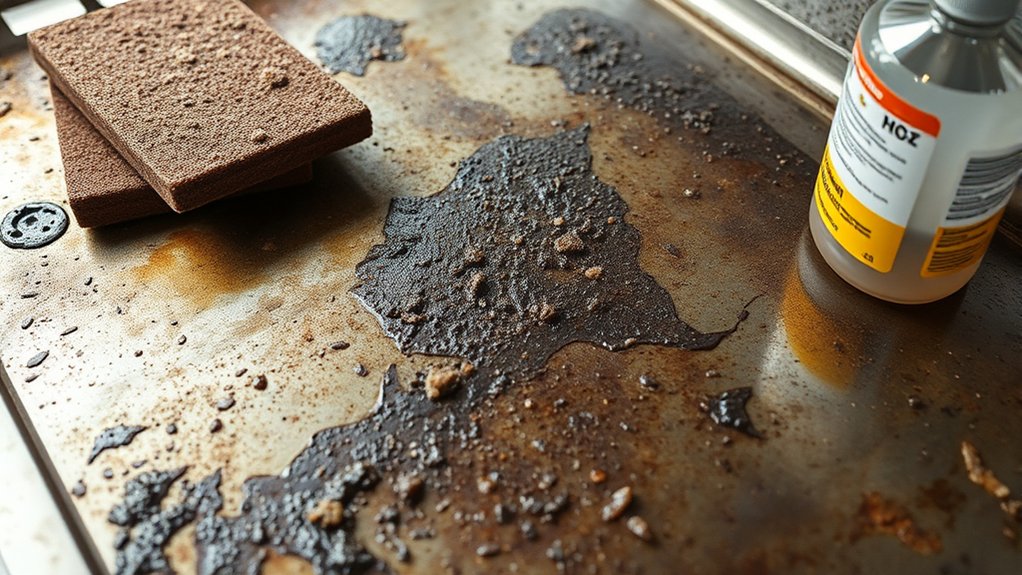
You’ll often face stubborn residue that requires scrubbing beyond a simple wipe-down. Maintaining your griddle also means routine seasoning to prevent rust and preserve the cooking surface.
Skipping these steps can degrade performance and reduce the lifespan of your equipment.
Stubborn Residue Removal
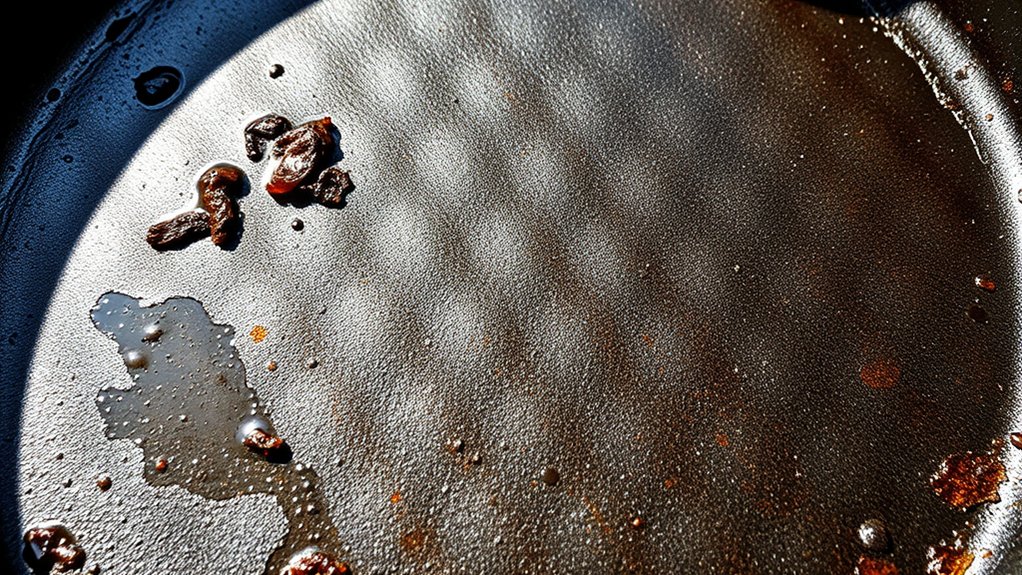
Because griddles often cook sticky or caramelized foods, removing stubborn residue can demand significant effort and specialized techniques. You’ll frequently encounter residue buildup that standard wiping won’t remove.
To tackle stubborn stains effectively, you need to use a combination of scraping tools and heat application. Applying a metal spatula or scraper at a precise angle helps dislodge adhered particles without damaging the surface.
Additionally, employing hot water or steam loosens residue, making subsequent cleaning easier. Avoid abrasive cleaners that could compromise the griddle’s finish.
Consistent attention to these stubborn stains prevents long-term degradation and maintains cooking efficiency. Understanding the physical properties of residue buildup and adapting your cleaning approach is essential to preserving your griddle’s performance over time.
Routine Seasoning Needs
Although griddles offer excellent cooking performance, they demand routine seasoning to maintain their nonstick properties and prevent rust. You must adhere to a strict routine seasoning frequency, typically after every few uses, to guarantee the surface remains protected.
Mastering seasoning application techniques, such as applying a thin, even layer of oil and heating it to the appropriate temperature, is critical. Neglecting this leads to uneven cooking surfaces and accelerated corrosion.
| Step | Description | Recommended Frequency |
|---|---|---|
| Cleaning | Remove food debris and grease | After each use |
| Drying | Thoroughly dry to prevent rust | After each use |
| Oil Application | Apply thin oil layer | Every 2-3 uses |
| Heating | Heat to polymerize oil | Each seasoning cycle |
| Inspection | Check for rust or damage | Weekly |
Routine seasoning demands precision and consistency to prolong griddle lifespan.
Cooking Styles That Don’t Work Well on Griddles
You’ll find griddles struggle with delicate baking tasks since their flat, open surface doesn’t provide consistent heat distribution like an oven.
Saucy dishes also pose a problem because liquids tend to spread and evaporate quickly on the griddle’s hot surface. These cooking styles demand controlled environments that griddles can’t reliably offer.
Delicate Baking Challenges
When you attempt delicate baking on a griddle, you quickly notice its limitations. Griddles provide broad, direct heat, which makes controlling precise baking temperatures challenging. This inconsistency affects delicate pastries, which require stable, moderate heat to rise and bake evenly.
Unlike ovens, griddles lack enclosed environments, causing uneven heat distribution and fluctuating surface temperatures that can scorch or undercook your dough. You also can’t easily regulate humidity or airflow, both critical for proper pastry texture.
For items like croissants or puff pastry, these factors cause poor layering and structural failure. While griddles excel at high-heat cooking, their inability to maintain controlled baking temperatures makes them unsuitable for delicate baking. If you want consistent results with fragile pastries, traditional ovens remain the superior choice.
Saucy Dish Limitations
Since griddles rely on a flat, open surface with direct heat, they struggle to contain and evenly cook dishes with abundant sauces or liquids. When you attempt saucy dishes on a griddle, the lack of raised edges causes liquids to spread uncontrollably, resulting in uneven cooking and potential mess.
This design limits your ability to maintain proper moisture levels, which is critical for flavor retention in saucy recipes. Additionally, the direct heat can cause rapid evaporation, altering the intended taste profile.
If you want consistent results with stews, curries, or any dish requiring simmering, a griddle won’t provide the necessary containment or heat control. Understanding these saucy dish limitations helps you select the right cookware to preserve flavor and achieve ideal texture.
Cost of Buying and Operating a Griddle
Although griddles offer versatile cooking options, their initial purchase and ongoing operational costs can be significant. When you consider buying a griddle, the initial investment often involves high-quality models designed for durability and even heating.
This upfront cost may exceed that of traditional stovetops or pans. Beyond purchase, long term expenses include energy consumption, as griddles require consistent power to maintain ideal cooking temperatures.
Additionally, you’ll need to budget for cleaning supplies and potential replacement parts like heating elements or drip trays. If you opt for a gas griddle, fuel costs also factor in.
These cumulative expenses can impact your budget more than expected, especially if you use the griddle frequently or commercially. Understanding these costs helps you weigh convenience against financial commitment.
Safety Concerns When Using a Griddle
Managing the cost and operation of a griddle goes hand in hand with understanding the safety risks involved. You must be vigilant about burn hazards since griddle surfaces and edges get extremely hot.
Electrical safety is another critical factor, especially if your griddle isn’t grounded properly or has exposed wiring. To minimize risks, always follow these safety precautions:
Use heat-resistant gloves when handling the griddle. Keep the power cord away from water and hot surfaces. Regularly inspect electrical components for damage.
Avoid overcrowding the cooking surface to prevent grease fires. Turn off and unplug the griddle immediately after use.
Frequently Asked Questions
Can Griddles Be Used Outdoors?
Yes, you can use griddles outdoors since many models support portable cooking. They excel at outdoor gatherings, offering even heat distribution and ample surface area.
Ensure proper ventilation and stable placement for safe, efficient use.
Are Griddles Compatible With Induction Cooktops?
Like a key fitting a lock, your griddle’s induction compatibility depends on cookware materials. If it’s magnetic, such as cast iron or stainless steel, it’ll work; otherwise, it won’t activate the induction cooktop’s magnetic field.
How Long Does It Take to Preheat a Griddle?
You’ll typically need 5 to 10 minutes to reach ideal griddle temperature settings. Preheating time varies by thickness and heat source, so monitor surface heat carefully to guarantee even cooking and prevent hot spots.
Do Griddles Require Seasoning Before First Use?
Yes, you’ll need seasoning techniques to protect your griddle’s surface; studies show seasoned griddles last 50% longer. Follow maintenance tips like oiling after each use to prevent rust and guarantee peak, consistent cooking performance.
Can Griddles Be Used to Cook Desserts?
You can use griddles for dessert recipes, mastering cooking techniques like even heat distribution for pancakes or caramelizing fruits. Their flat surface supports precise temperature control, enhancing texture and flavor in various sweet preparations.
Conclusion
Using a griddle is like steering a large ship through narrow channels—you gain expansive cooking space but must navigate tight turns carefully. You’ll appreciate the broad surface, yet uneven heating and maintenance can feel like hidden reefs threatening your voyage. Some dishes won’t sail smoothly here, and costs alongside safety require constant attention.
If you’re ready to chart this course with precision and care, the griddle can become a powerful tool in your culinary fleet. However, it’s important to weigh these disadvantages of a griddle before fully committing to its use.

Leave a Reply